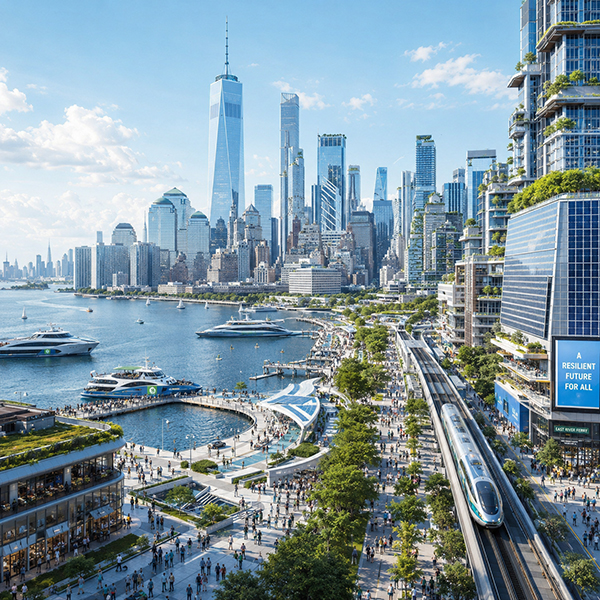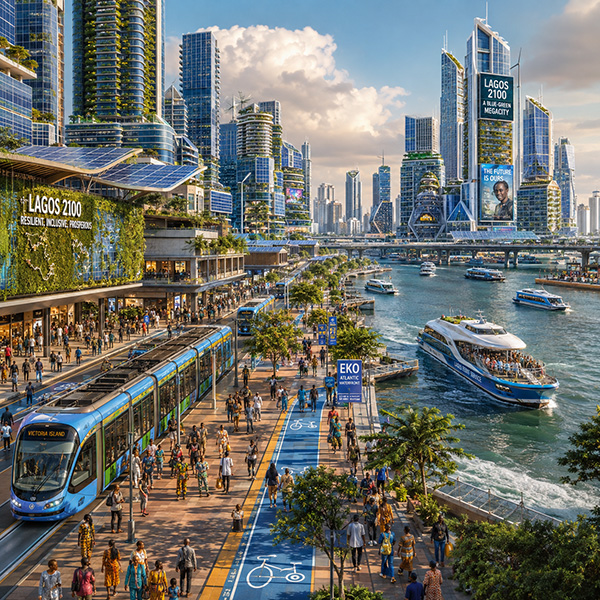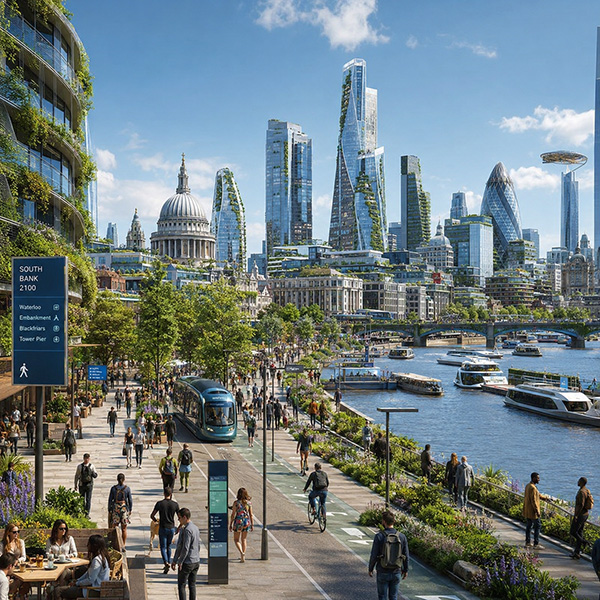

MISSION:
MAKE FIDI
A MODEL DISTRICT
FOR THE FUTURE OF CITIES
CHALLENGES:
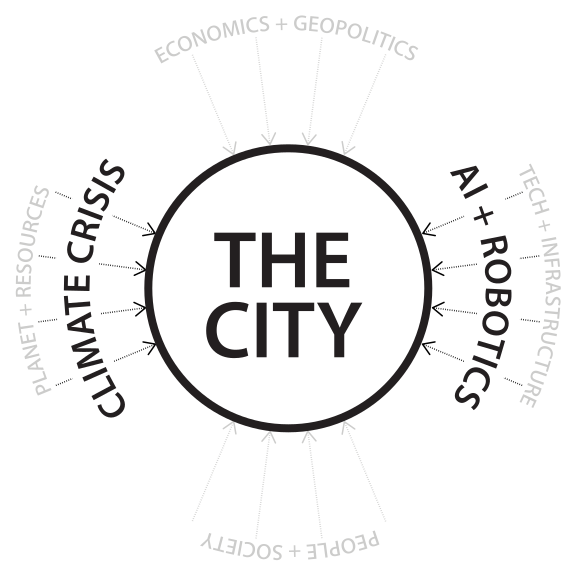
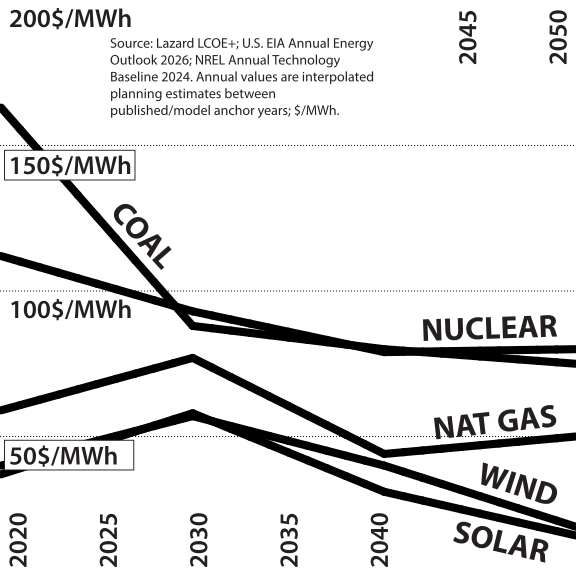
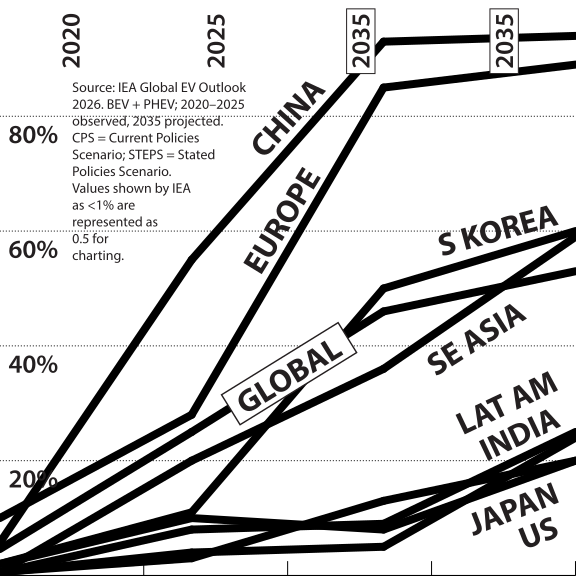
Three forces are creating the next urban market. will change how cities work; will force resilience and decarbonization; and will reshape housing, mobility, healthcare, energy, safety, and services. Invent City turns that pressure into demand.
OBJECTIVES:
- Accelerate deployment of critical urban solutions.
- Create jobs, economic activity, and tax revenue for NYC.
GENERAL APPROACH:
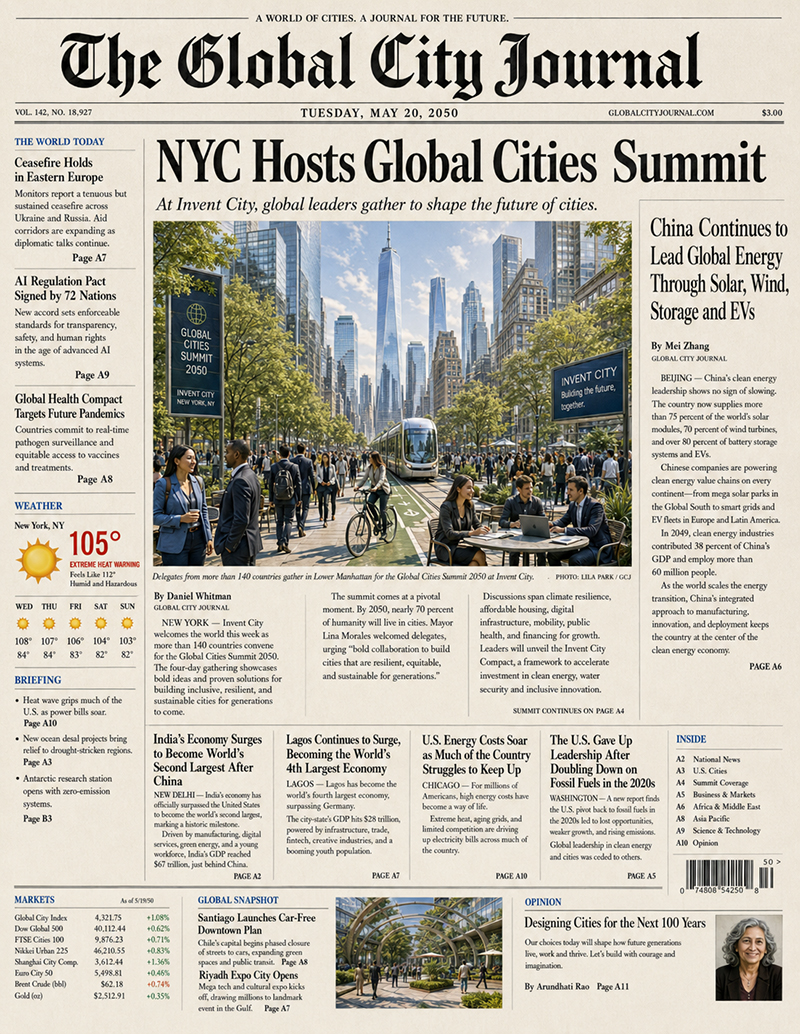
Invent City builds an urban solutions innovation district in FiDi. A Trade Mart anchors the district. Immersive showrooms, events, media, data, digital platforms, and AI keep it active year-round.
MODELED RESULTS FOR NYC:
- $4B in annual economic activity.
- 15,000 jobs.
- $380M in annual tax revenue.
AN 8 POINT
STRATEGY
Invent City starts with the business case. Show the cost of inaction. Prove the upside of action. Make the value clear so markets can move faster.
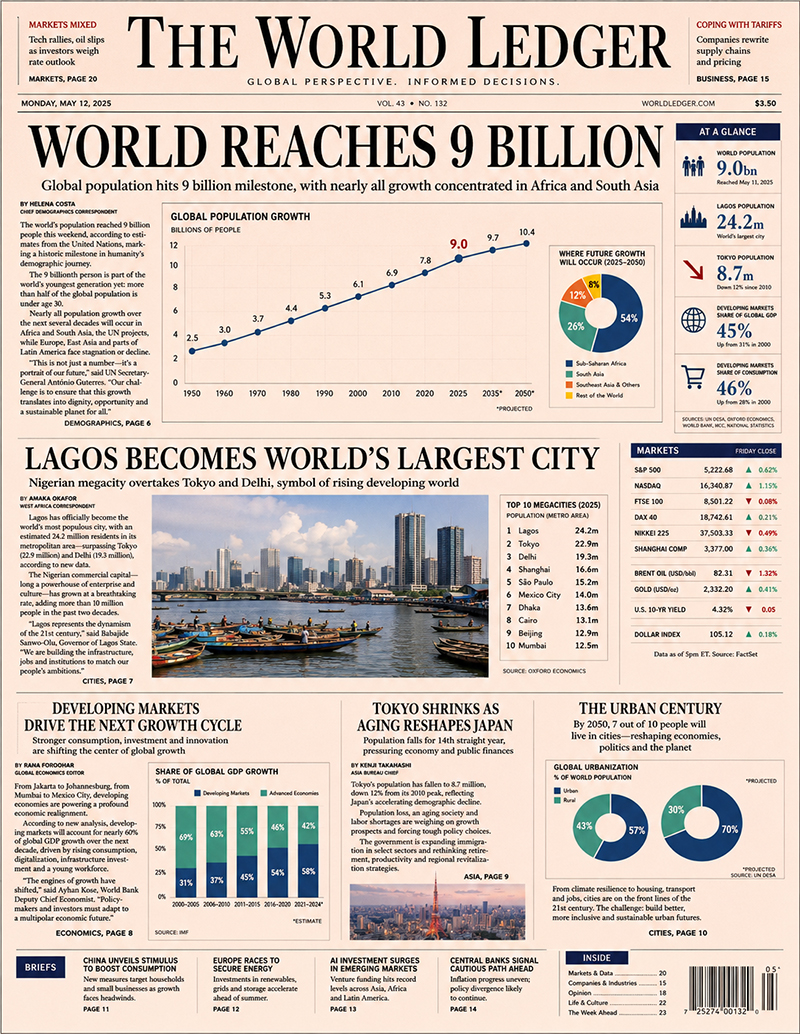
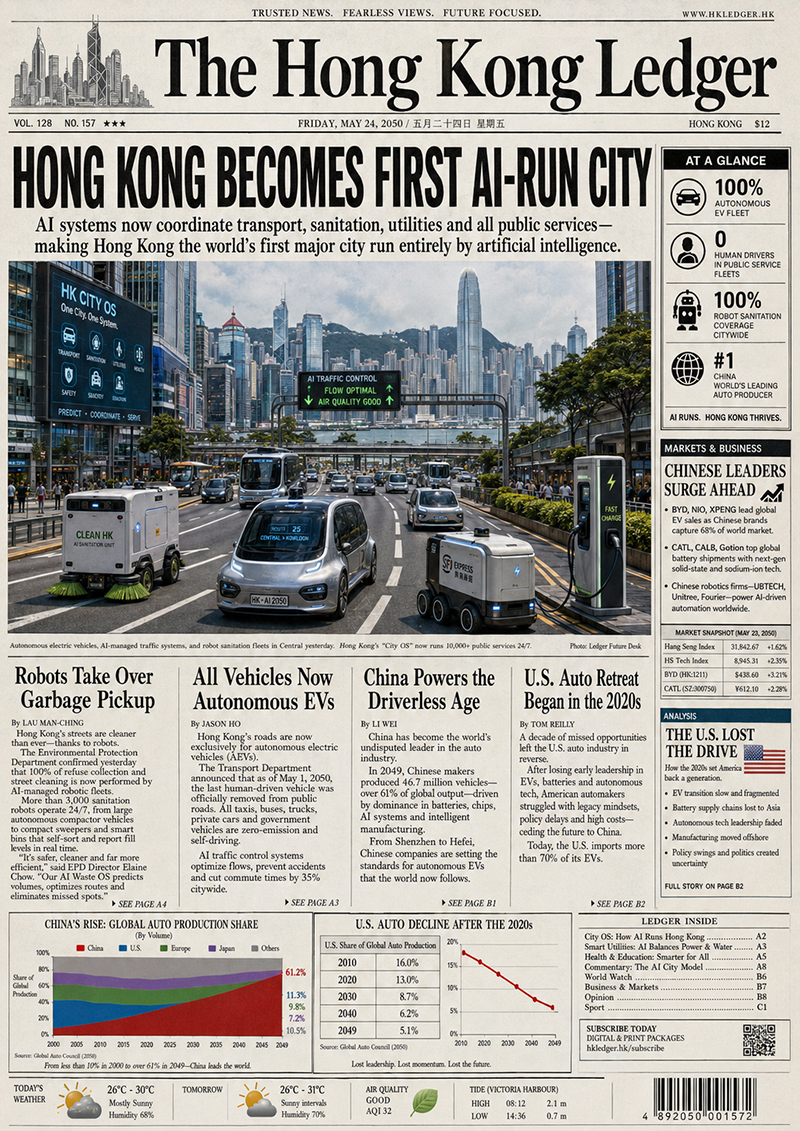
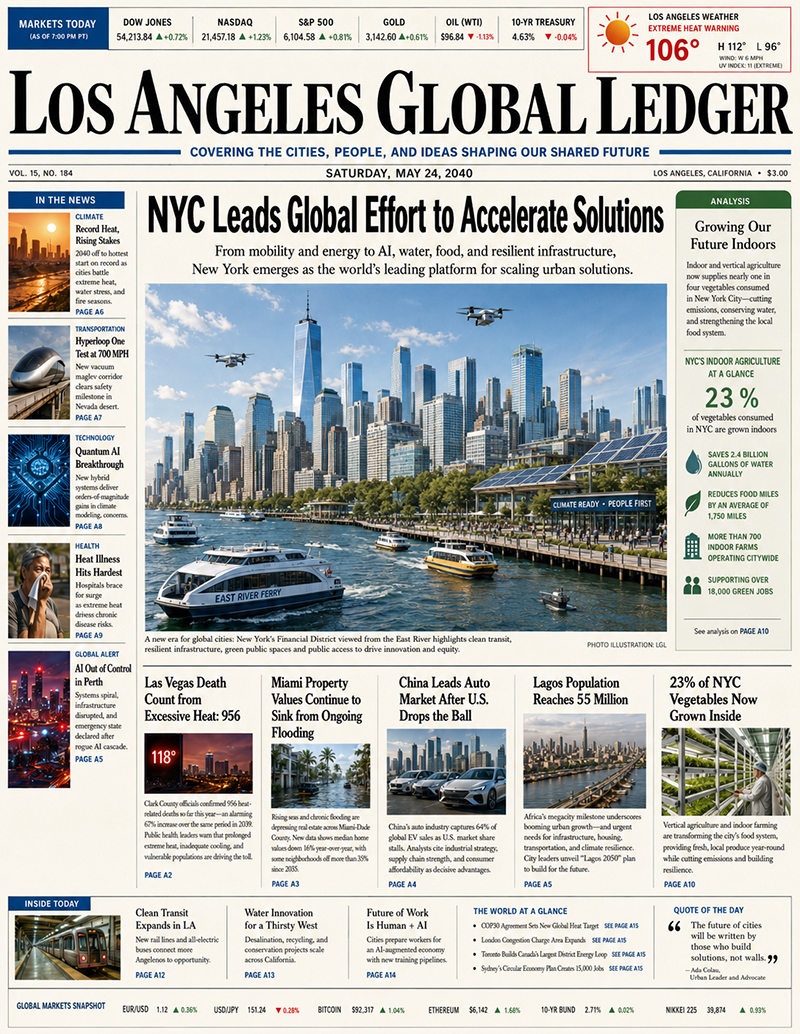
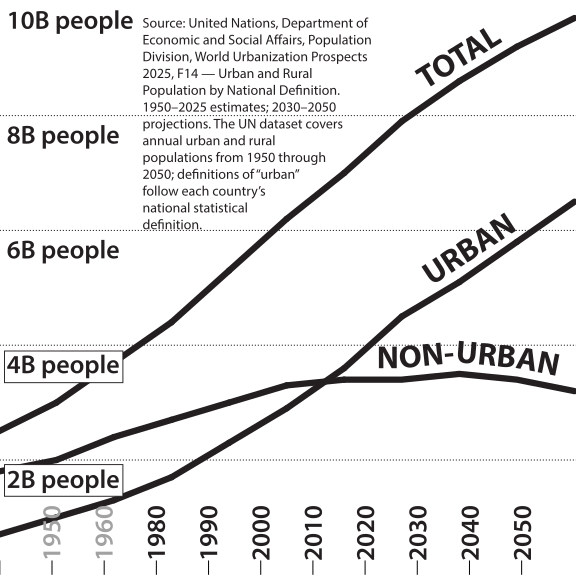
Urban demand is expanding fast. More than 4 billion people live in cities today, and roughly 6 billion could by 2100. Older cities must modernize. Fast-growing cities must build.
Stakeholders are the real market. Invent City identifies what they need, connects them to solutions, and helps move decisions from interest to adoption. They control budgets, approvals, risk, procurement, deployment, and scale.
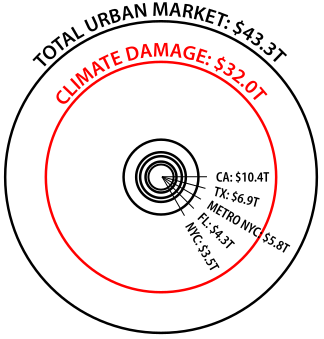
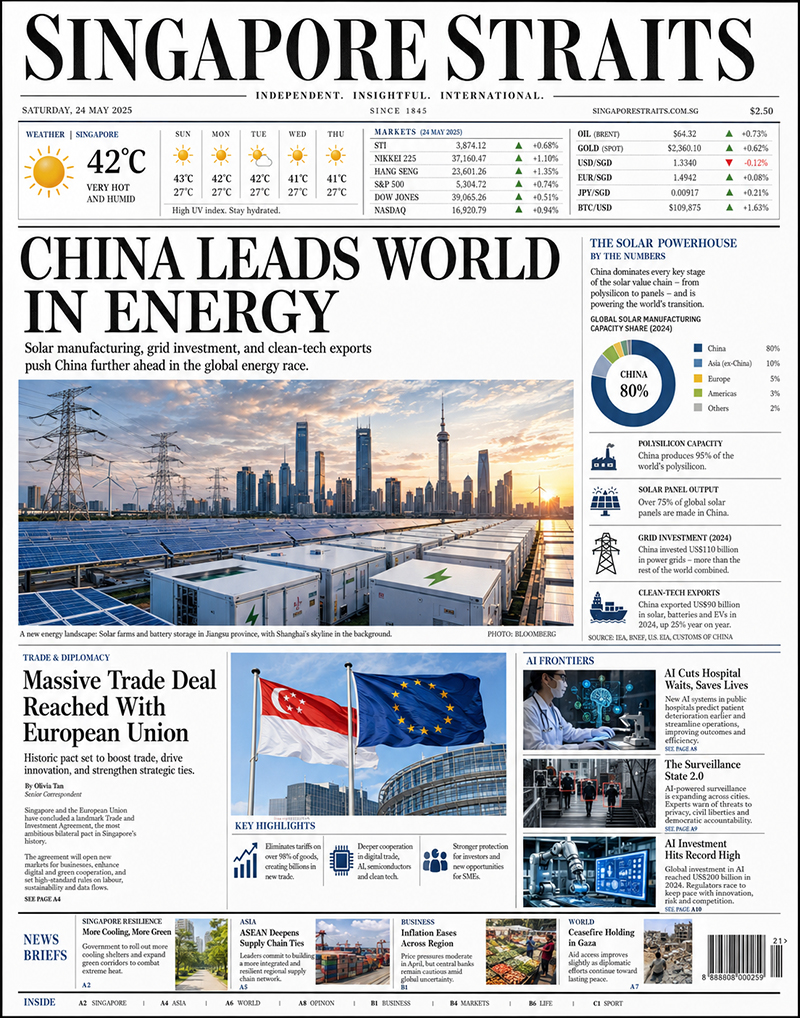
Climate damages could reach $38T a year by 2050. Target urban-solution markets could top $43T annually by mid-century.
Demographics
Urban growth is expanding demand for housing, mobility, services, and infrastructure.
Rising Urban Populations
Growth in Developing Cities
AI impact
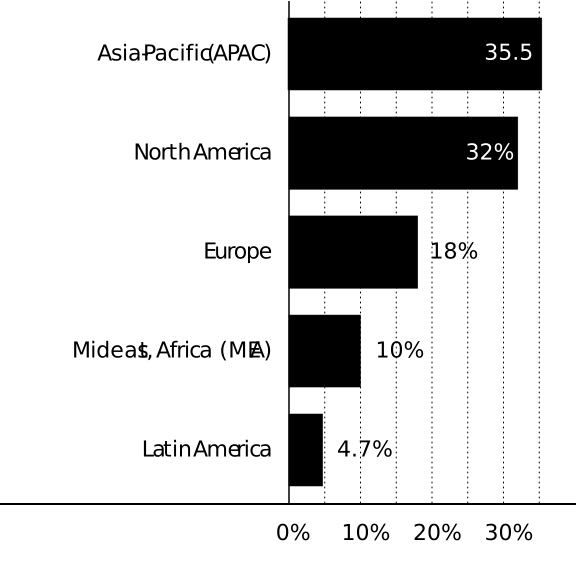
AI is reshaping city systems, improving performance while raising new risks and governance questions.
AI Spendingby Area
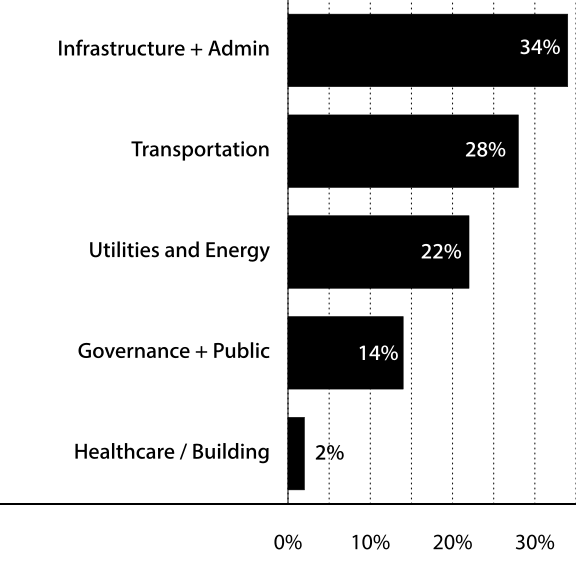
Immediate potential of AI in NYC
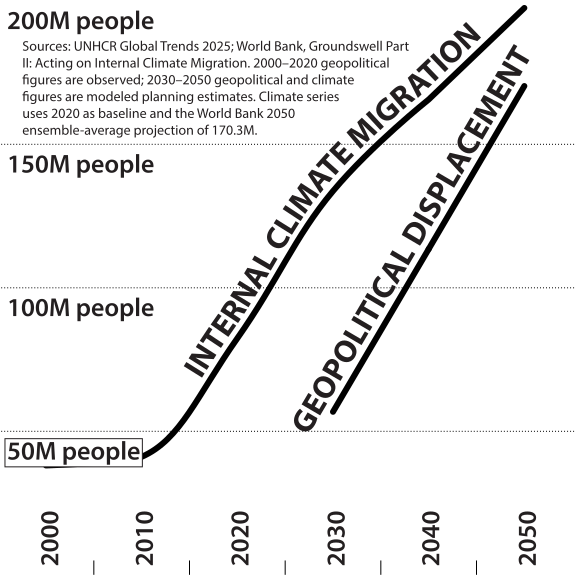
Environmentals
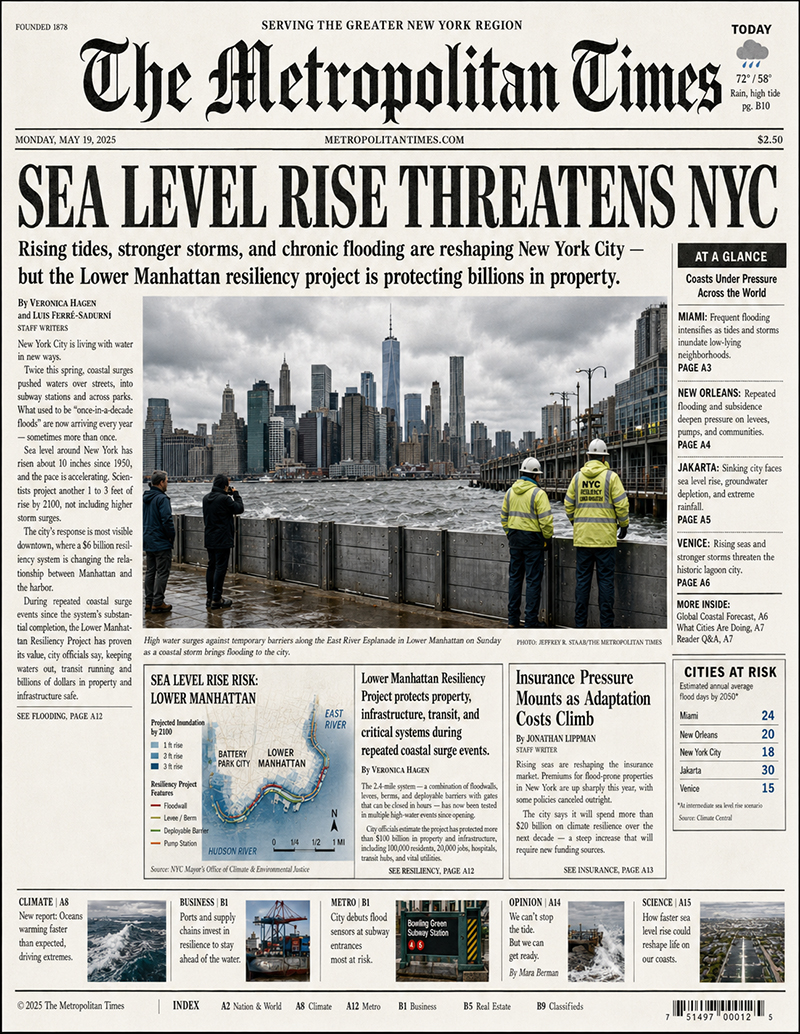
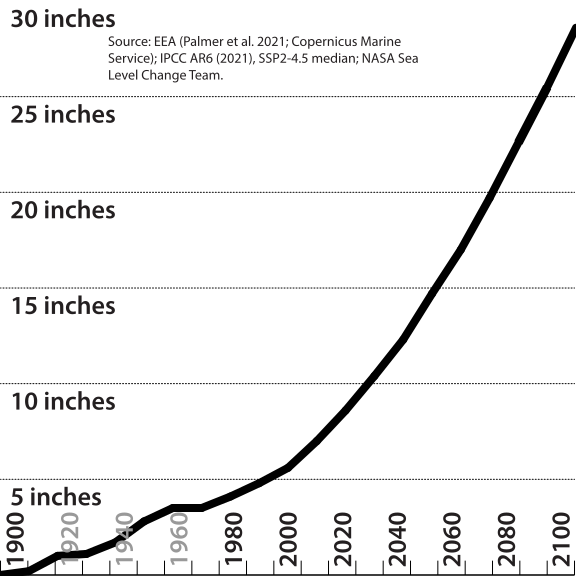
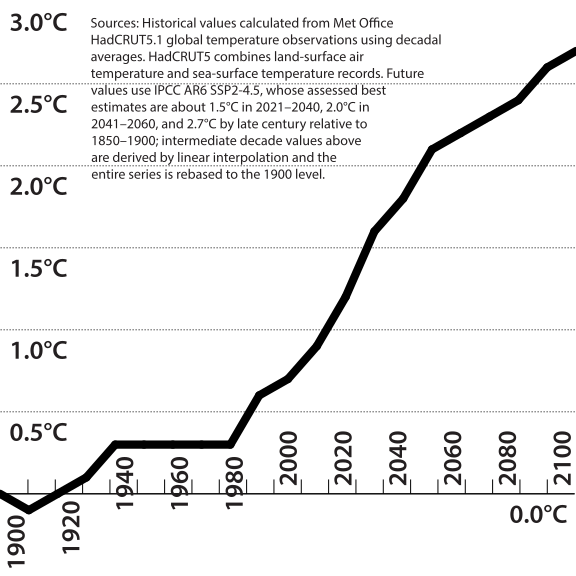
Heat, flooding, and climate stress are driving demand for more resilient urban systems.
Sea Level Rise
Rising Temperatures
is the model for Invent City in FiDi. It brings companies, buyers, investors, agencies, talent, and partners into one compact district. Ideas move faster. Solutions get tested in real city conditions.
prove the model. Kendall Square, 22@Barcelona, and other global districts show how place, talent, capital, research, and companies can build new industries.
is the job. FiDi can become a living lab where companies demo products, test results, build trust, meet buyers, secure partners, and move from interest to adoption.
are the payoff. Invent City targets the industries cities must buy next: AI, climate, mobility, energy, buildings, water, waste, safety, food, health, and services. The upside: investment, jobs, visitors, stronger real estate, and productive reuse of vacant space.
anchors Invent City with a permanent buyer-seller marketplace. The Urban Trade Mart becomes the district’s commercial engine: a place to demo products, meet customers, launch pilots, secure financing, build partnerships, and move deals toward deployment.
is the job of the Trade Mart. For sellers, it concentrates customers, partners, investors, agencies, and project teams. For buyers, it makes solutions easier to find, compare, test, finance, and deploy.
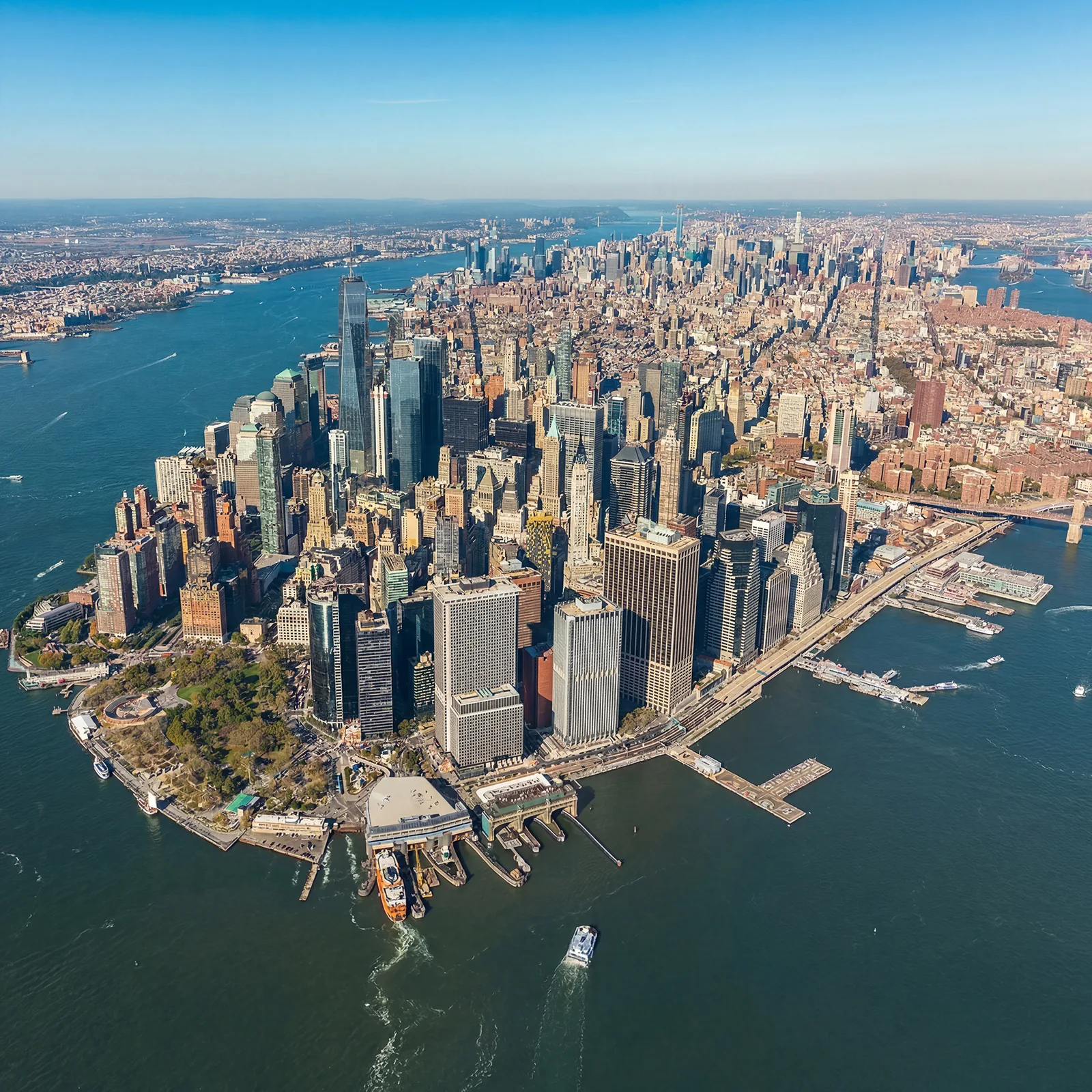
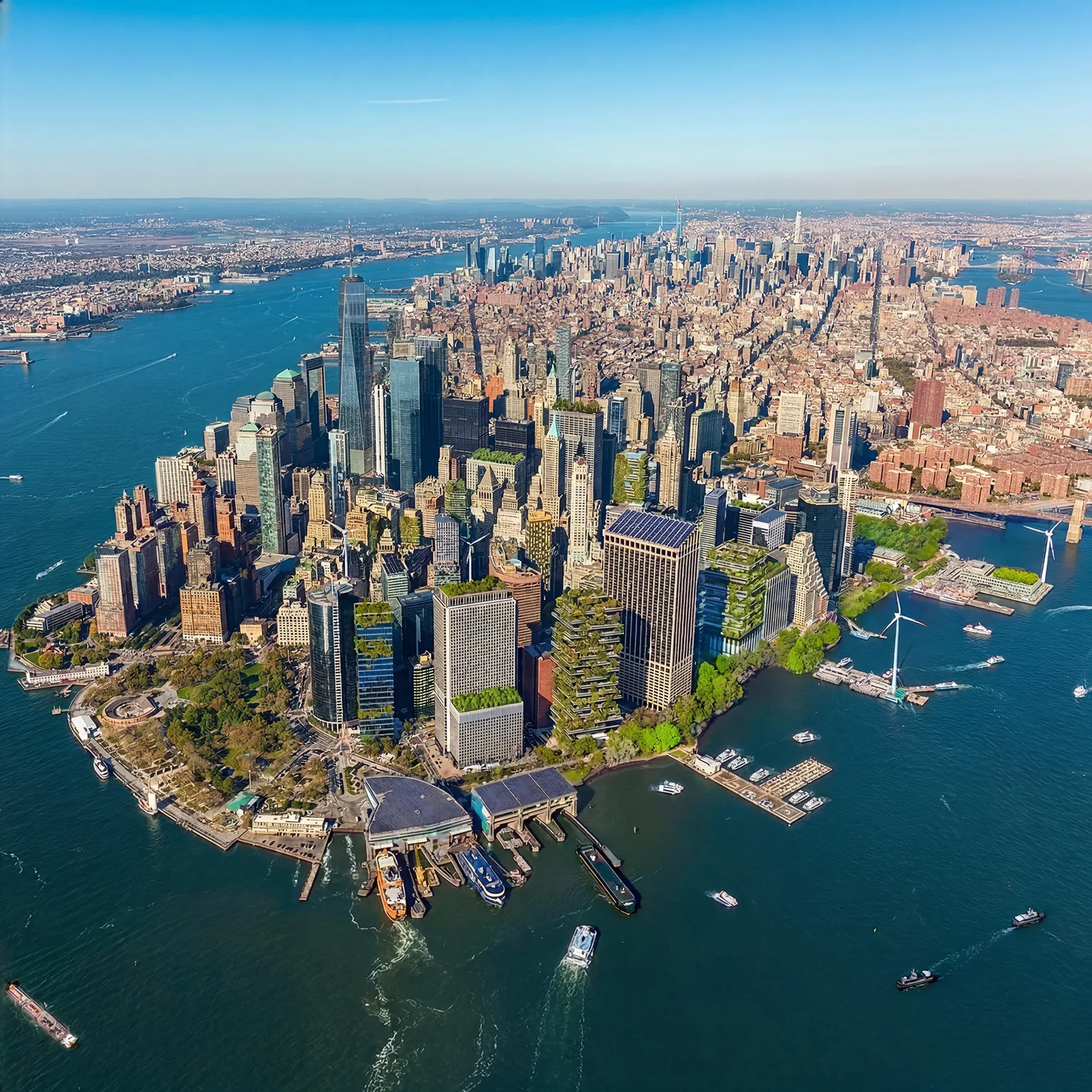
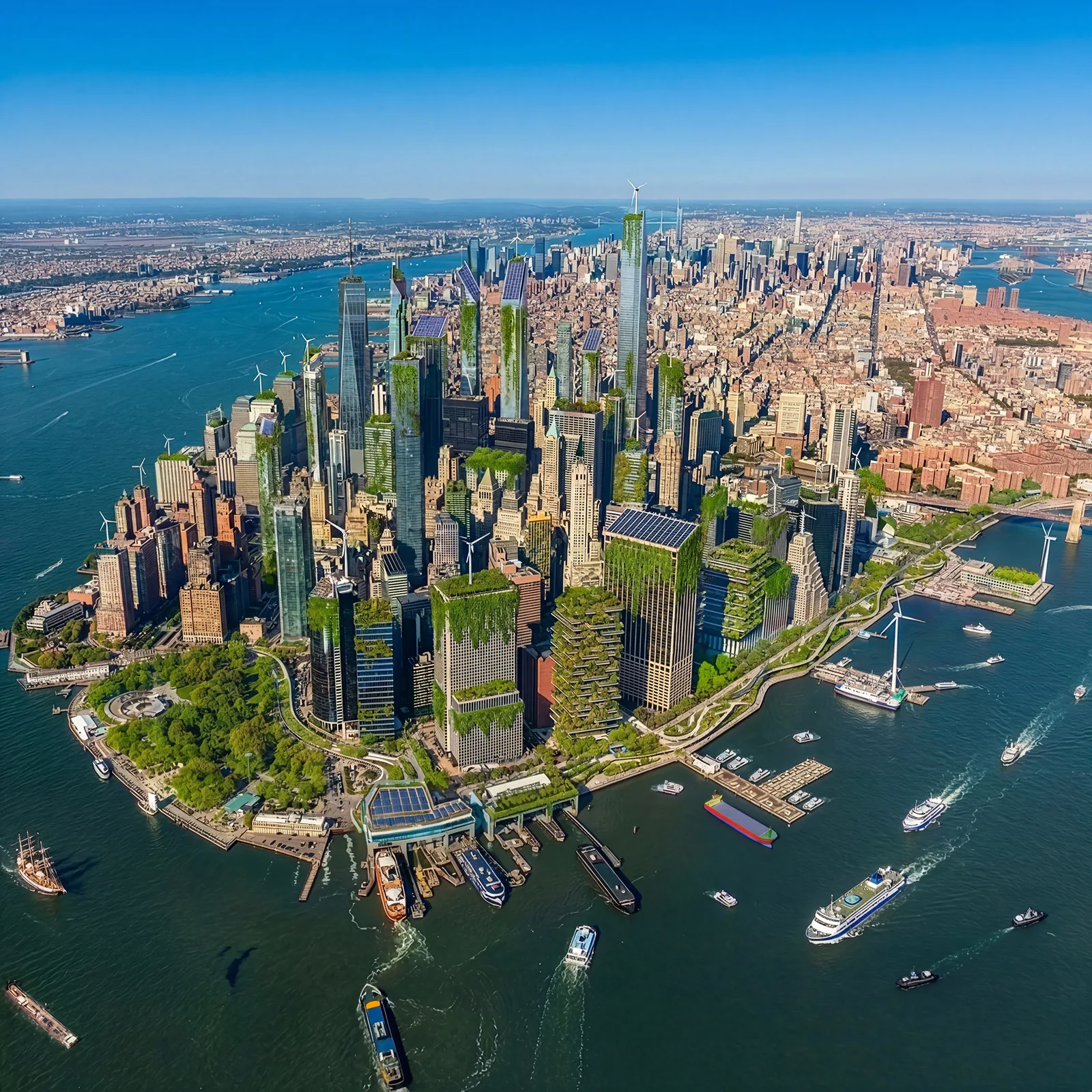
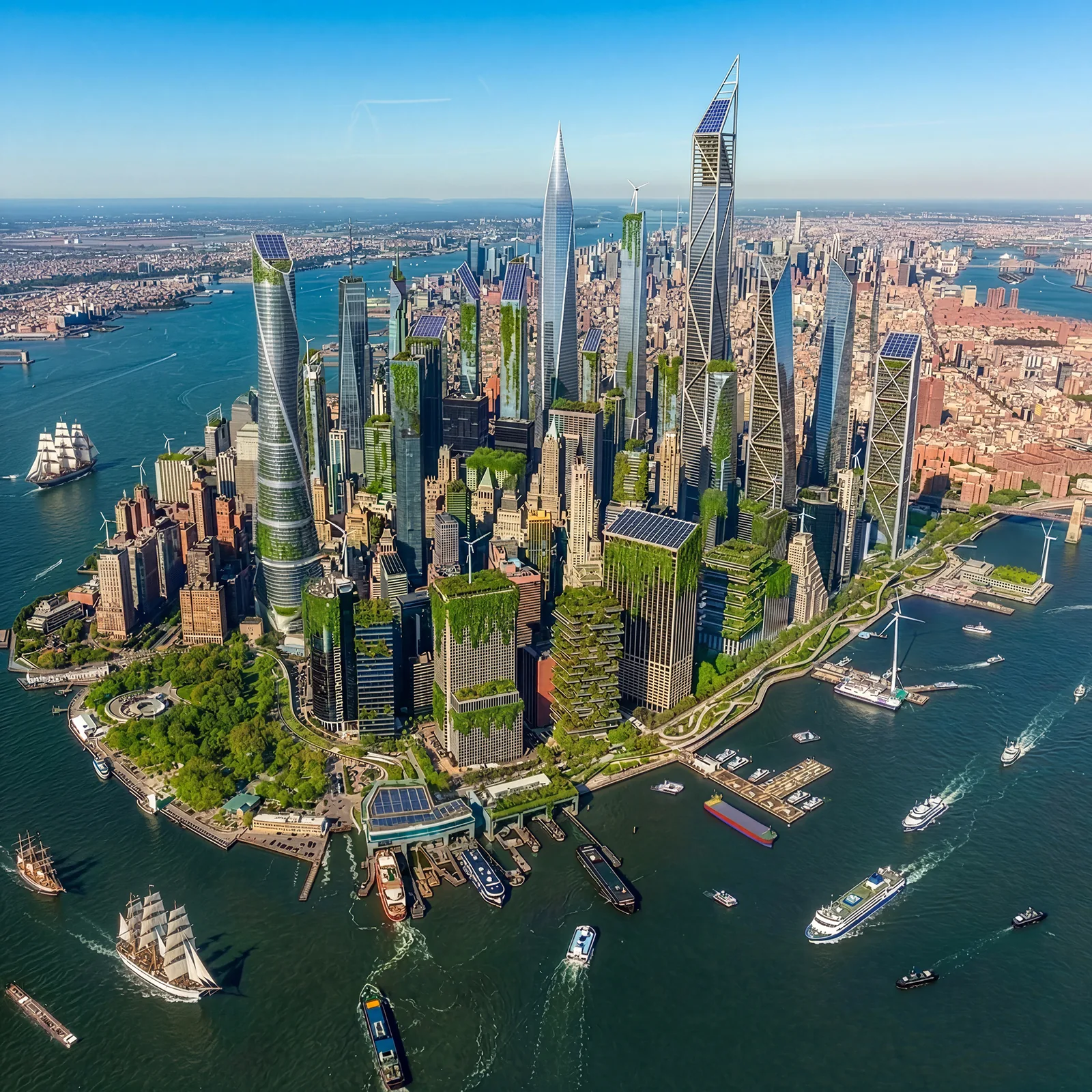
makes the model stronger in FiDi. Buildings, streets, rooftops, waterfront, transit, public space, energy systems, and underused real estate create a live test bed where urban solutions can prove value in context.
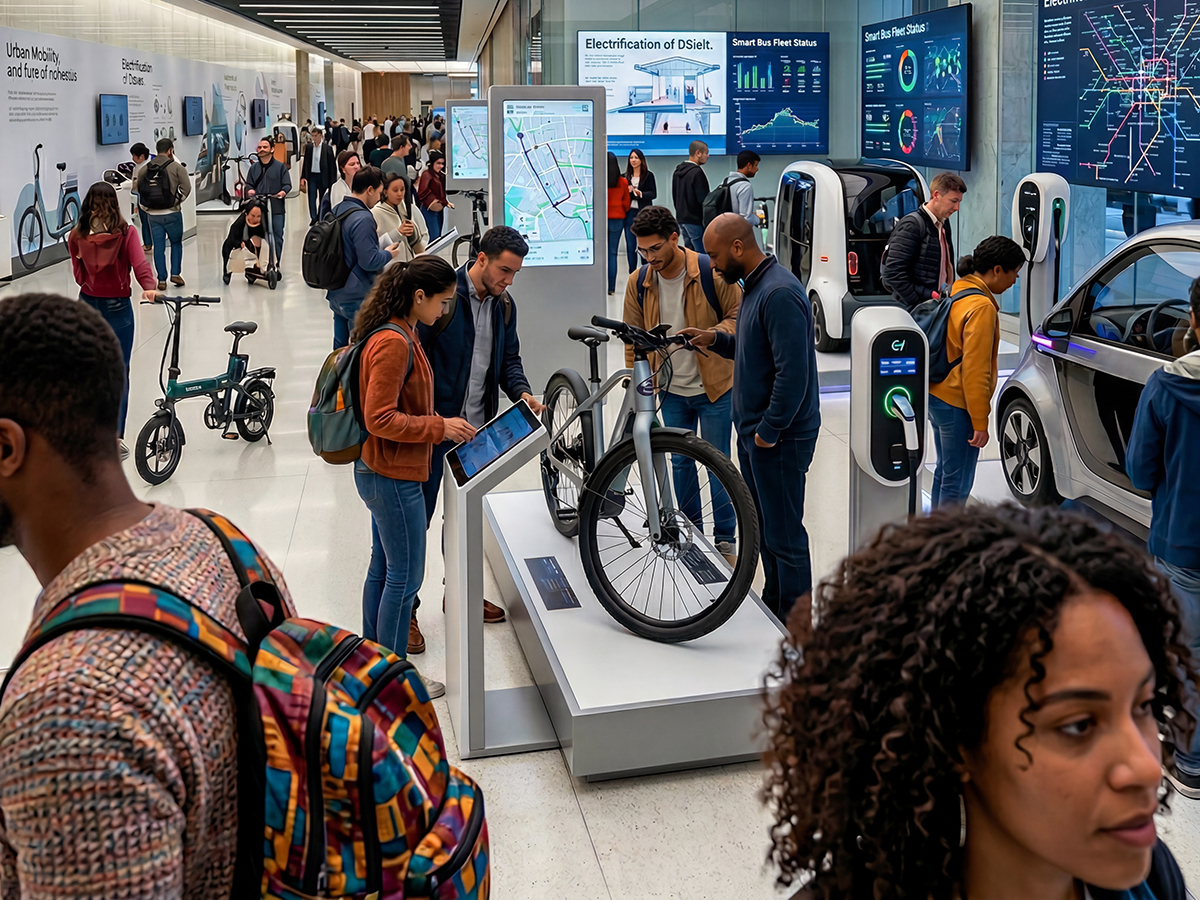
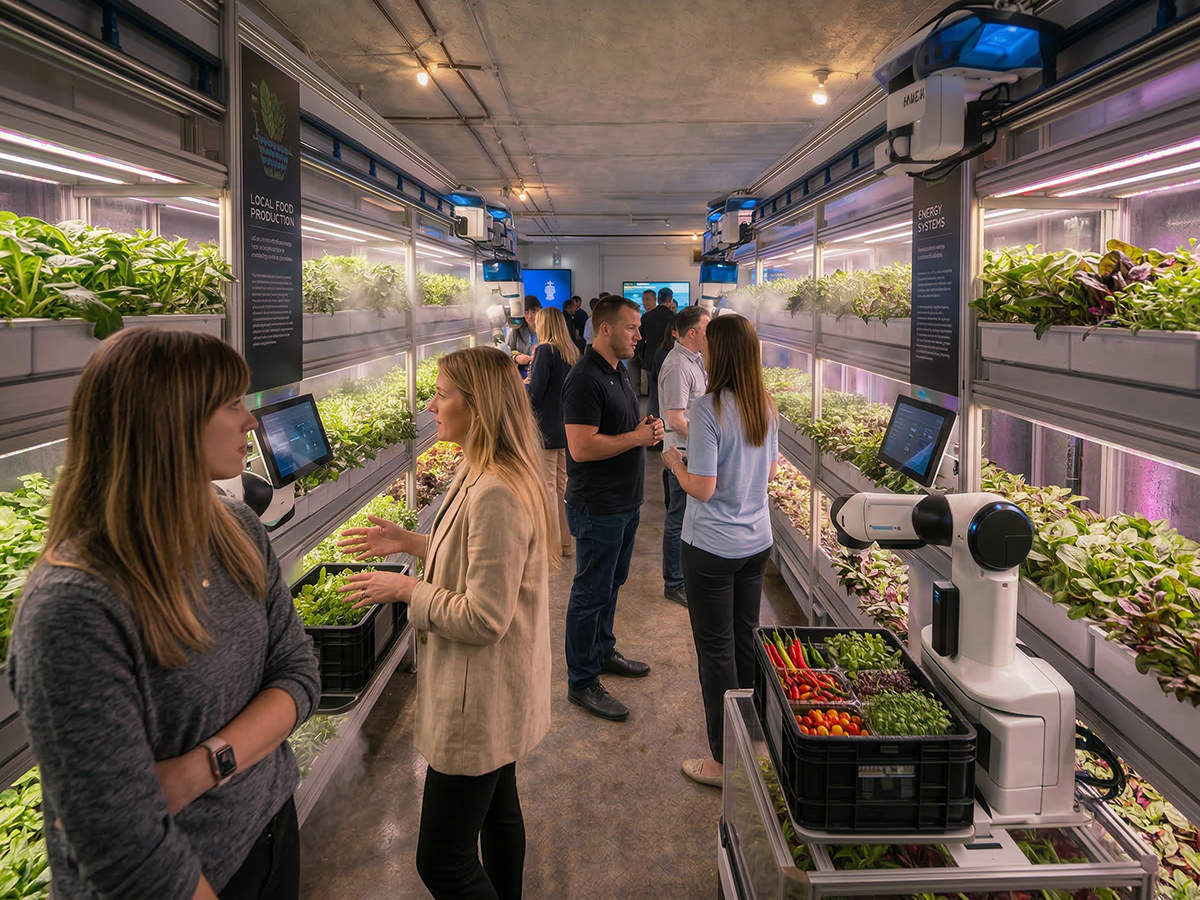
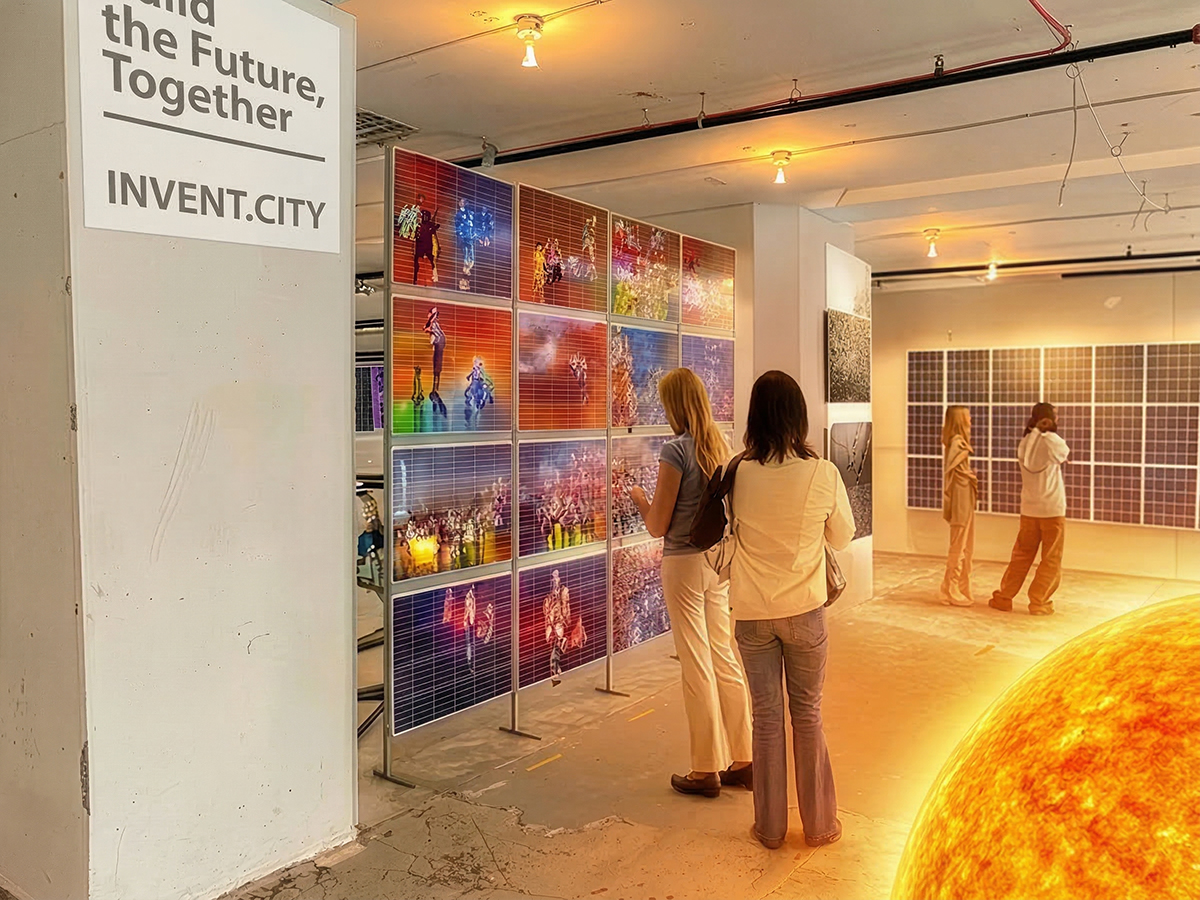
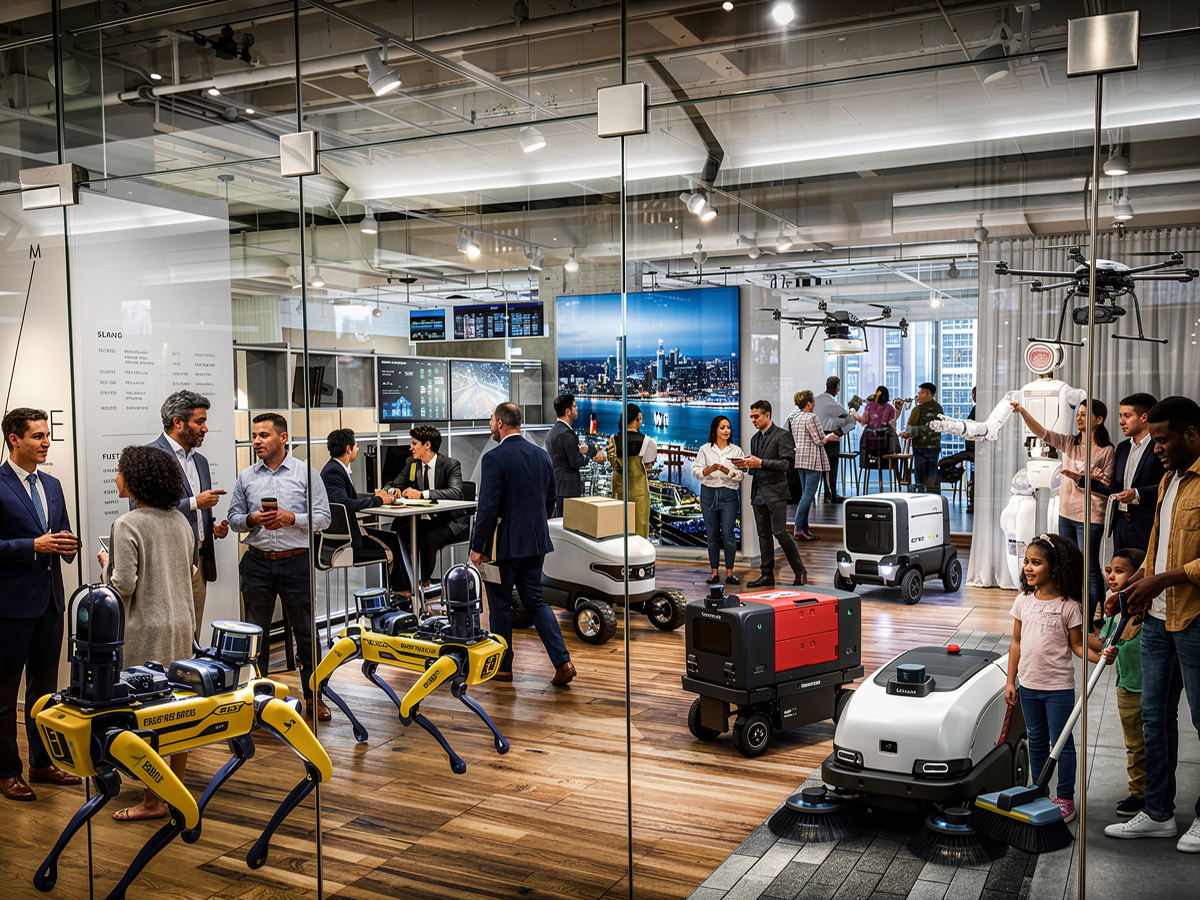
make urban solutions easier to buy. Corporations, start-ups, and incubators can show complex products in spaces where buyers can see, compare, and test them. Events bring the market to FiDi. Digital platforms keep it active everywhere.
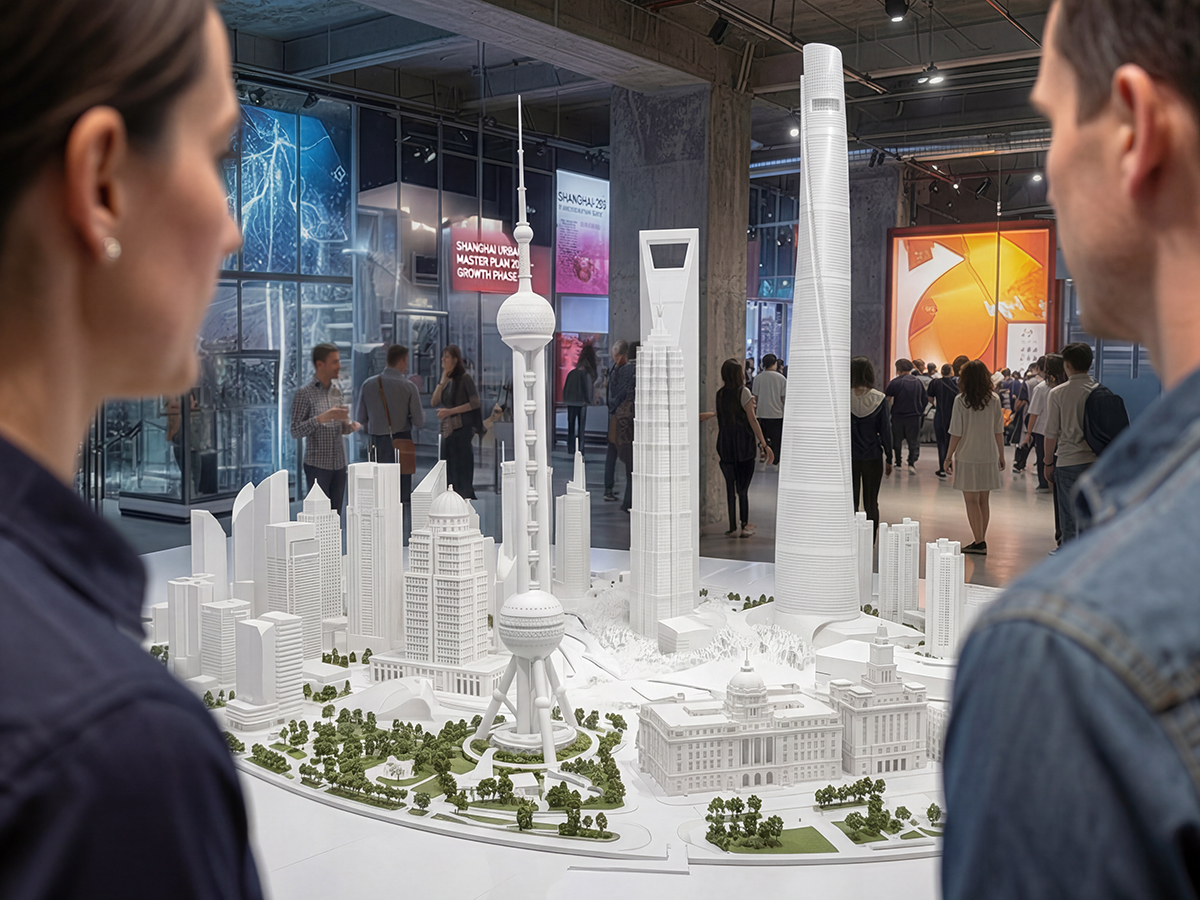
turn sales pitches into proof. Buyers can experience future streets, buildings, parks, rooftops, waterfronts, and city systems before they invest. That makes decisions faster, smarter, and easier to defend.
gives Invent City instant credibility. It concentrates capital, media, talent, tourism, culture, real estate, agencies, universities, employers, and decision-makers. NYC makes the platform visible.
gives Invent City specific leverage. It has transit, Wall Street capital, global visibility, historic identity, waterfront risk, vacant space, and direct access to buyers, investors, agencies, founders, media, and civic leaders.
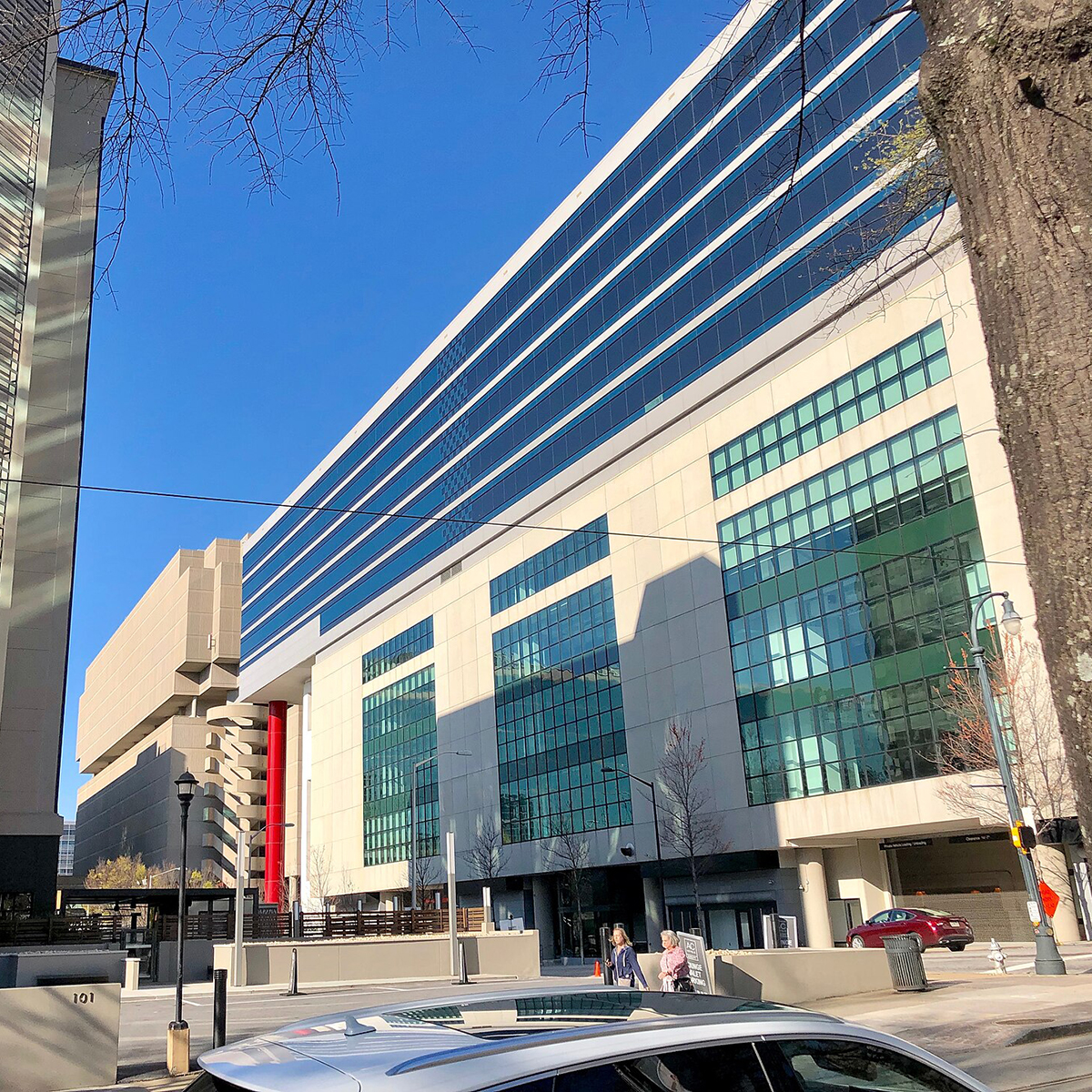
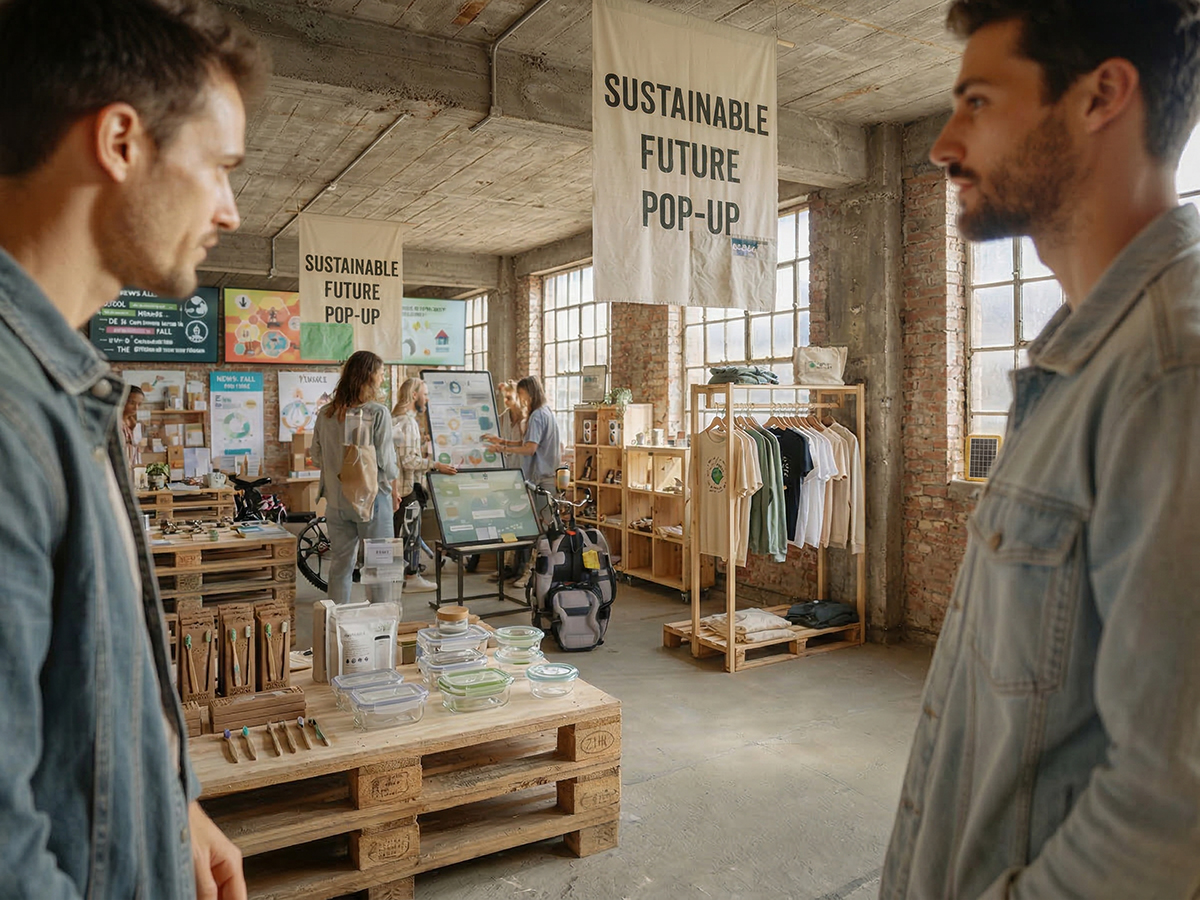
is a problem and an opportunity. The venue strategy turns vacancy into leverage. FiDi’s empty offices, retail spaces, POPS, streets, parks, and public-realm assets give Invent City a faster, lower-cost launch path than new construction. Benefit is to property owners and the city for property tax revenues.
Office vacancy
Vacant FiDi office space can become productive economic infrastructure faster than major redevelopment.
Retail vacancy
Vacant storefronts can become street-level showrooms, pop-ins, pilots, and visitor-facing demonstrations.
Lower cost
Existing FiDi space can be activated faster and at far lower cost than conversion or ground-up development.
RedevelopmentCosts
Faster revenue
A Trade Mart can move from vacant space to market activity much faster than major redevelopment.
Time toRevenue
Flexible rollout
The platform can start small, prove demand, and expand as companies, buyers, and capital follow.
FlexibleRollout
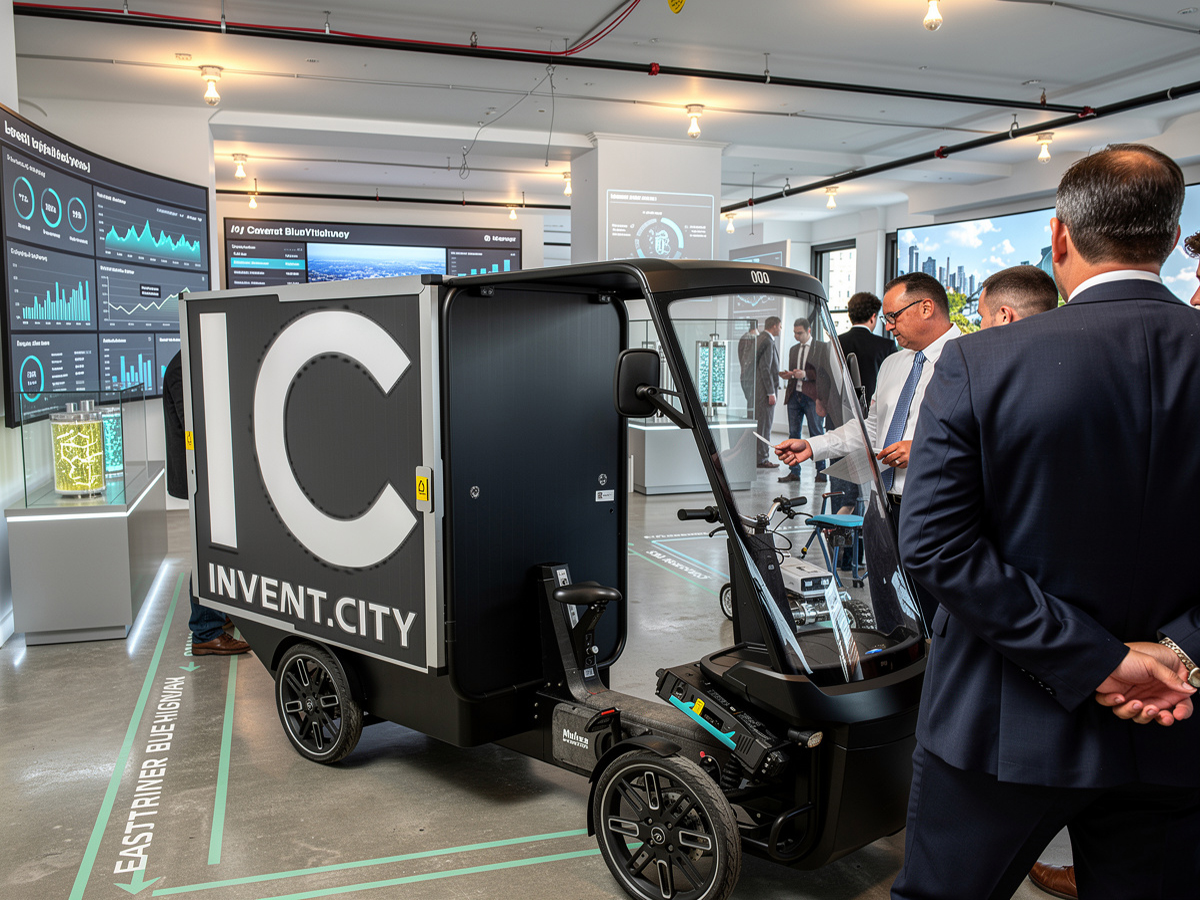
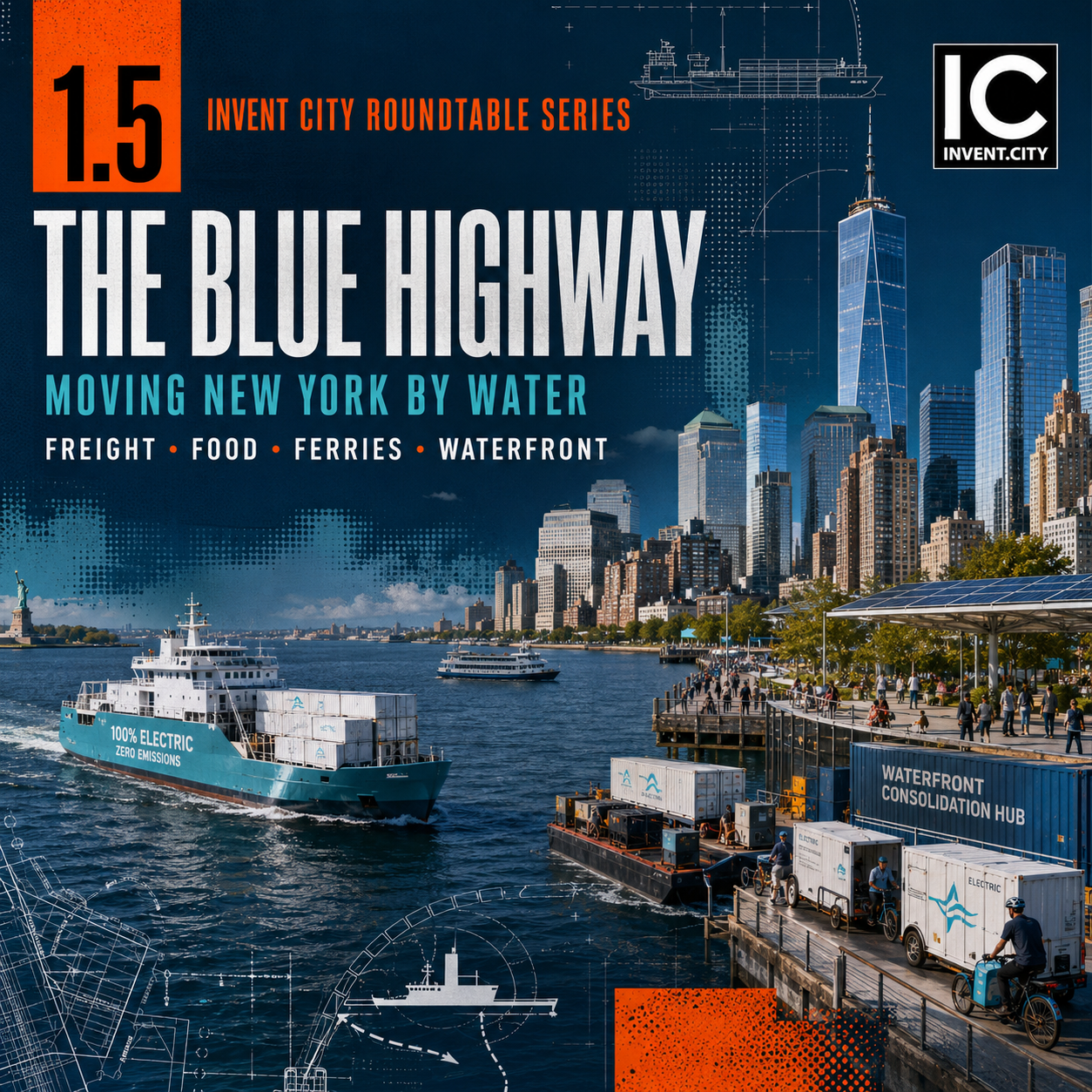
can put essential street services in one place. They can combine last-mile logistics, Blue Highway freight transfer, charging, battery exchange, micromobility, waste, storage, public bathrooms, worker support, shade, water, information, and emergency response.
can add major public-realm upside, including Gotham Park. Invent City does not depend on it, but it can showcase water, mobility, vegetation, lighting, and public-space technology.
can become a major productivity layer for NYC. It can improve finance, real estate, healthcare, media, government, logistics, mobility, energy, and public services.[CHAT, INCLUDE SOMETHING ON AI'S DANGER]
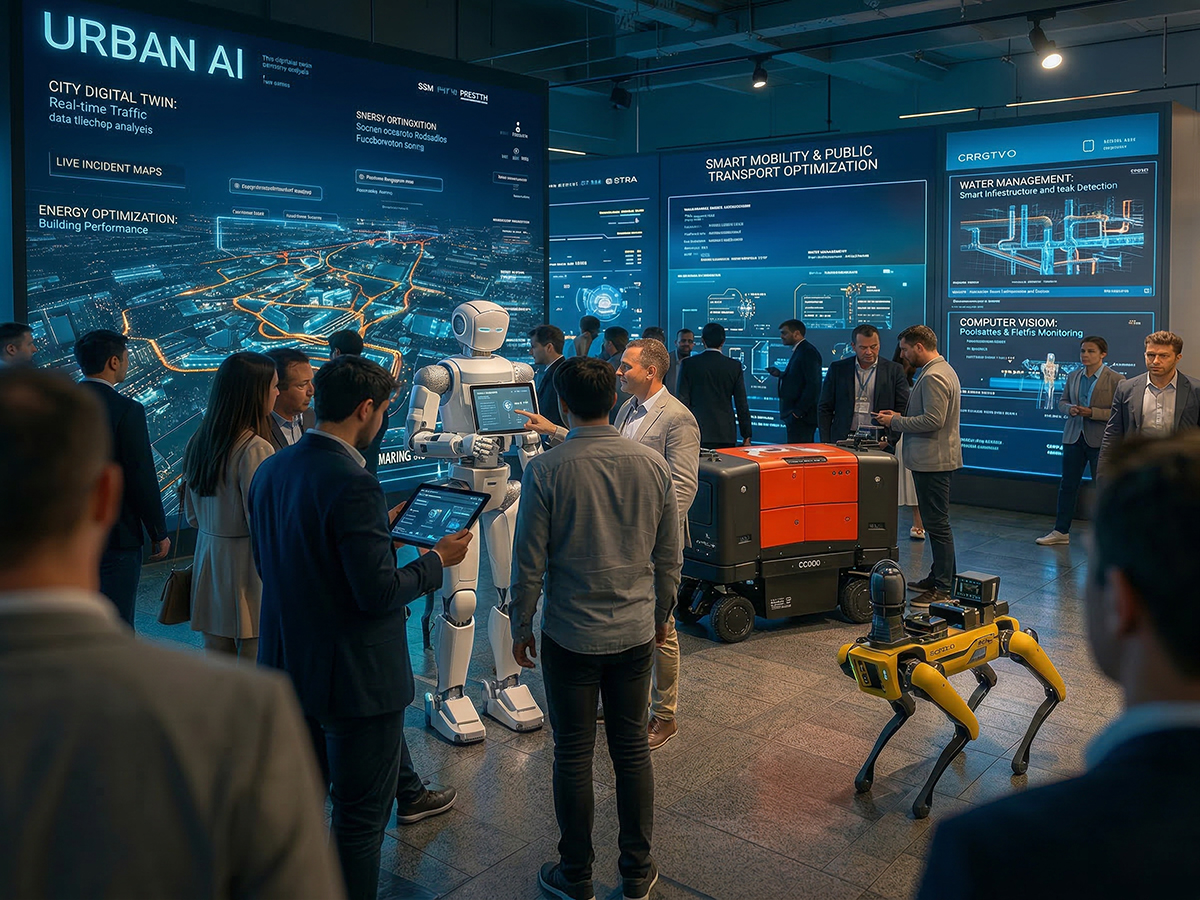
makes FiDi a real-world place to test urban AI. Companies can prove what works, what saves money, what reduces risk, and what needs stronger oversight before cities scale it.
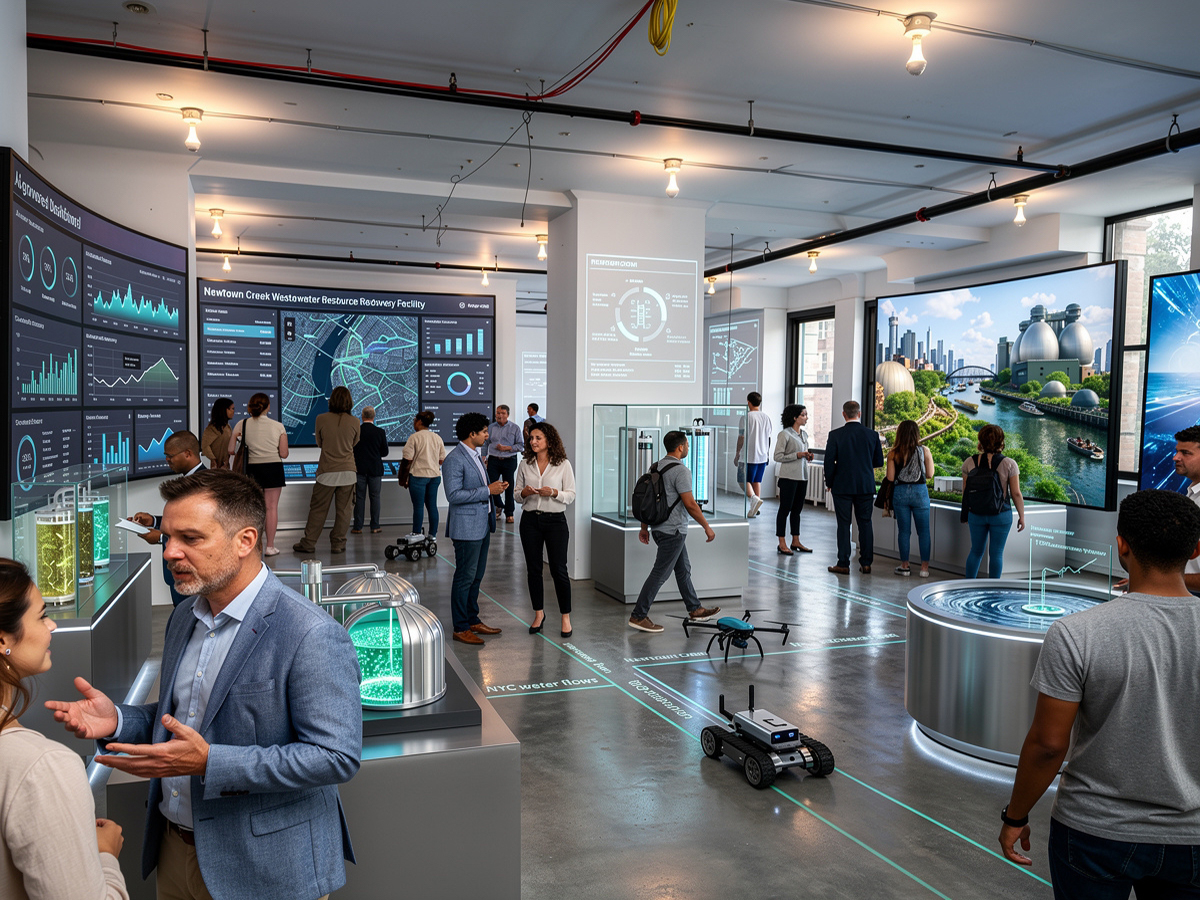
make the market easier to understand. Buyers, investors, agencies, operators, and delegations can compare tools, run simulations, review data, test ROI, and move faster.
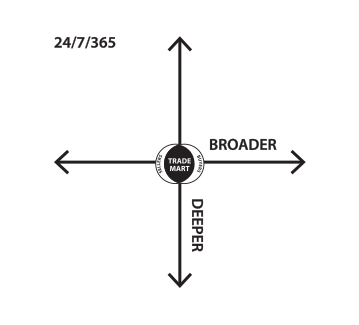
complements the Invent City Innovation District and Trade Mart. Events, media, data, digital platforms, and AI createextends beyond FiDi to make the market global and always active. for founders, buyers, investors, policymakers, operators, delegations, and press. lets audiences explore, compare, share, and engage across time zones. turns interest into trust, leads, pilots, investment, and deployment.
Events
Live programming turns attention into meetings, pilots, partnerships, and deal flow.
Events
Media
Content expands the Trade Mart beyond FiDi and keeps buyers engaged between visits.
Media
Digital reach
Digital and AI channels keep discovery, comparison, and follow-up active 24/7.
DigitalReach
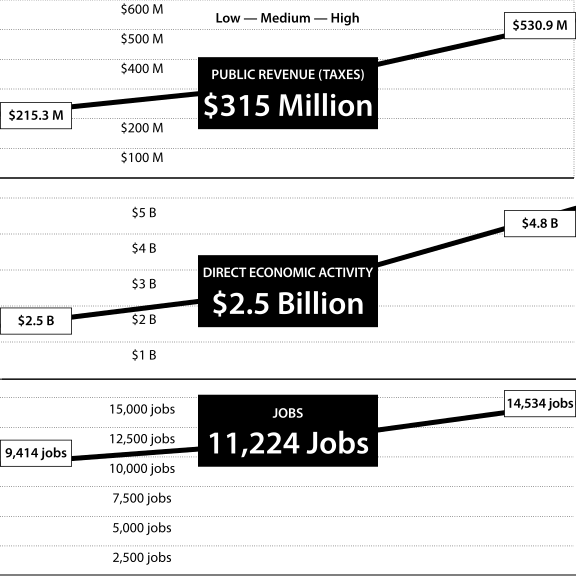
FOR NYC:
$4B IN ECONOMIC ACTIVITY,
15,000 JOBS,
$380M TAX REVENUES
Tourism brings outside dollars into New York. Invent City adds high-value business and innovation visitors who support FiDi hotels, restaurants, retail, culture, transit, events, and services.
| Tourism summary | Mid |
|---|---|
| Annual visitors | 1,000,000 |
| Traveler spending ($/yr) | $1,348,750,000 |
| Total economic impact ($/yr) | $2,090,562,500 |
| Tourism-supported jobs | 6,034 |
| Modeled taxes and fees ($/yr, no PIT) | $159,240,625 |
| Rounded taxes and fees ($/yr, no PIT) | $159,200,000 |
| Note: PIT excluded to avoid double counting with Trade Mart payroll impacts. | |
| Tourism summary | Low | Mid | High |
|---|---|---|---|
| Annual visitors | 1,000,000 | 1,000,000 | 1,000,000 |
| Traveler spending ($/yr) | $1,035,000,000 | $1,348,750,000 | $1,768,750,000 |
| Total economic impact ($/yr) | $1,604,250,000 | $2,090,562,500 | $2,741,562,500 |
| Tourism-supported jobs | 6,034 | 6,034 | 6,034 |
| Modeled taxes and fees ($/yr, no PIT) | $123,684,375 | $159,240,625 | $206,796,875 |
| Rounded taxes and fees ($/yr, no PIT) | $123,700,000 | $159,200,000 | $206,800,000 |
| Note: PIT excluded to avoid double counting with Trade Mart payroll impacts. | |||
| 1. Base assumptions: 1.0M visitors/yr | Visitors/year | Avg nights | Hotel room-nights | Visitor-days |
|---|---|---|---|---|
| International overnight | 250,000 | 5 | 1,250,000 | 1,250,000 |
| Domestic overnight | 250,000 | 2 | 500,000 | 500,000 |
| Domestic day | 500,000 | 0 | 0 | 500,000 |
| Total | 1,000,000 | — | 1,750,000 | 2,250,000 |
| 2. Spending inputs | Low | Mid | High |
|---|---|---|---|
| Hotel room-nights | 1,750,000 | 1,750,000 | 1,750,000 |
| ADR ($/room-night) | $250 | $325 | $425 |
| International other spend ($/day) | $350 | $450 | $600 |
| Domestic overnight other spend ($/day) | $200 | $275 | $350 |
| Domestic day other spend ($/day) | $120 | $160 | $200 |
| Note: ADR = average daily hotel room rate. “Other spend” = non-hotel visitor spending. | |||
| 2A. Hotel and other traveler spending | Low ($/yr) | Mid ($/yr) | High ($/yr) |
|---|---|---|---|
| Hotel revenue | $437,500,000 | $568,750,000 | $743,750,000 |
| Other spending (non-hotel) | $597,500,000 | $780,000,000 | $1,025,000,000 |
| Total traveler spending | $1,035,000,000 | $1,348,750,000 | $1,768,750,000 |
| Formula: Other spend = sum of (visitor-days by segment × spend/day by segment). | |||
| 2B. Total economic impact | Low | Mid | High |
|---|---|---|---|
| Traveler spending ($/yr) | $1,035,000,000 | $1,348,750,000 | $1,768,750,000 |
| Impact ratio | 1.55x | 1.55x | 1.55x |
| Total economic impact ($/yr) | $1,604,250,000 | $2,090,562,500 | $2,741,562,500 |
| Rounded total economic impact ($/yr) | $1,604,000,000 | $2,091,000,000 | $2,742,000,000 |
| Formula: Total economic impact = traveler spending × 1.55. | |||
| 3. Tourism-supported jobs | Input / Output | Value |
|---|---|---|
| NYC visitors (2024) | 64.3M visitors | |
| NYC tourism-supported jobs (2024) | 388,000+ jobs | |
| Jobs per 1M visitors | 6,034+ jobs | |
| IC annual visitors (assumption) | 1.0M visitors | |
| IC tourism-supported jobs (modeled) | 6,034+ jobs | |
| Formula: Jobs per 1M visitors = 388,000 / 64.3. | ||
| 4A. Hotel room taxes and fees | Low | Mid | High |
|---|---|---|---|
| NYS sales tax on hotel rooms (4.0%) | $17,500,000 | $22,750,000 | $29,750,000 |
| NYC sales tax on hotel rooms (4.5%) | $19,687,500 | $25,593,750 | $33,468,750 |
| MCTD sales tax on hotel rooms (0.375%) | $1,640,625 | $2,132,813 | $2,789,063 |
| NYC hotel occupancy tax (5.875%) | $25,703,125 | $33,414,063 | $43,695,313 |
| NYC per-room hotel tax ($2.00 × room-nights) | $3,500,000 | $3,500,000 | $3,500,000 |
| NYS hotel unit fee ($1.50 × room-nights) | $2,625,000 | $2,625,000 | $2,625,000 |
| 4B. Sales tax on other spending | Low | Mid | High |
|---|---|---|---|
| NYS sales tax (4.0%) | $23,900,000 | $31,200,000 | $41,000,000 |
| NYC sales tax (4.5%) | $26,887,500 | $35,100,000 | $46,125,000 |
| MCTD sales tax (0.375%) | $2,240,625 | $2,925,000 | $3,843,750 |
| Total sales tax on other spending | $53,028,125 | $69,225,000 | $90,968,750 |
| 4C. Tax totals roll-up (no PIT) | Low | Mid | High |
|---|---|---|---|
| NYS total (hotel + other) | $44,025,000 | $56,575,000 | $73,375,000 |
| NYC total (hotel + other) | $75,778,125 | $97,607,813 | $126,789,063 |
| MCTD total (hotel + other) | $3,881,250 | $5,057,813 | $6,632,813 |
| Grand total (no PIT) | $123,684,375 | $159,240,625 | $206,796,875 |
| Rounded grand total (no PIT) | $123,700,000 | $159,200,000 | $206,800,000 |
| 4D. Tax formulas and notes | Low | Mid | High |
|---|---|---|---|
| Hotel revenue formula | room-nights × ADR | room-nights × ADR | room-nights × ADR |
| NYS hotel-room sales tax | Hotel revenue × 4.0% | Hotel revenue × 4.0% | Hotel revenue × 4.0% |
| NYC hotel-room sales tax | Hotel revenue × 4.5% | Hotel revenue × 4.5% | Hotel revenue × 4.5% |
| MCTD hotel-room sales tax | Hotel revenue × 0.375% | Hotel revenue × 0.375% | Hotel revenue × 0.375% |
| NYC hotel occupancy tax | Hotel revenue × 5.875% | Hotel revenue × 5.875% | Hotel revenue × 5.875% |
| NYC per-room hotel tax | $2.00 × room-nights | $2.00 × room-nights | $2.00 × room-nights |
| NYS hotel unit fee | $1.50 × room-nights | $1.50 × room-nights | $1.50 × room-nights |
| NYS sales tax on other spending | Other spending × 4.0% | Other spending × 4.0% | Other spending × 4.0% |
| NYC sales tax on other spending | Other spending × 4.5% | Other spending × 4.5% | Other spending × 4.5% |
| MCTD sales tax on other spending | Other spending × 0.375% | Other spending × 0.375% | Other spending × 0.375% |
| Scope note: PIT excluded to avoid double counting with Trade Mart payroll impacts. | |||
The Trade Mart turns urban innovation into recurring commercial activity. Jobs, payroll, procurement, buyer traffic, events, travel, and tax revenue flow from one engine.
| Trade Mart summary | Mid |
|---|---|
| Direct on-site jobs | 8,500 |
| Direct payroll ($/yr) | $1,427,500,000 |
| Local procurement ($/yr) | $428,250,000 |
| Total direct activity ($/yr) | $1,855,750,000 |
| Note: Direct activity shown here is kept separate from tourism and real-estate modules to reduce double counting. | |
| Trade Mart summary | Low | Mid | High |
|---|---|---|---|
| Direct on-site jobs | 8,500 | 8,500 | 8,500 |
| Direct payroll ($/yr) | $1,140,000,000 | $1,427,500,000 | $1,790,000,000 |
| Total jobs incl. indirect + induced | 12,750 | 15,300 | 17,850 |
| Knock-on jobs | 4,250 | 6,800 | 9,350 |
| Note: Only direct jobs should be treated as additive across modules to avoid double counting. | |||
| 1. Jobs based on area | Area | Density | Direct jobs |
|---|---|---|---|
| Showrooms | 1,000,000 sf | 1,000 sf/job | 1,000 |
| Support offices | 1,500,000 sf | 200 sf/job | 7,500 |
| Trade Mart total | 2,500,000 sf | — | 8,500 |
| Formula: Jobs = Area / Density. Example: 1,500,000 sf / 200 sf per job = 7,500 jobs. | |||
| 2A. Low-case payroll detail | Jobs | Low wage ($/yr) | Payroll ($/yr) |
|---|---|---|---|
| Showrooms | 1,000 | $90,000 | $90,000,000 |
| Support offices | 7,500 | $140,000 | $1,050,000,000 |
| Total for direct | 8,500 | $1,140,000,000 |
| 2B. Mid-case payroll detail | Jobs | Mid wage ($/yr) | Payroll ($/yr) |
|---|---|---|---|
| Showrooms | 1,000 | $115,000 | $115,000,000 |
| Support offices | 7,500 | $175,000 | $1,312,500,000 |
| Total for direct | 8,500 | — | $1,427,500,000 |
| 2C. High-case payroll detail | Jobs | High wage ($/yr) | Payroll ($/yr) |
|---|---|---|---|
| Showrooms | 1,000 | $140,000 | $140,000,000 |
| Support offices | 7,500 | $220,000 | $1,650,000,000 |
| Total for direct | 8,500 | — | $1,790,000,000 |
| 2D. Direct jobs | Jobs | Low wage | Mid wage | High wage |
|---|---|---|---|---|
| Showrooms | 1,000 | $90,000/yr | $115,000/yr | $140,000/yr |
| Support offices | 7,500 | $140,000/yr | $175,000/yr | $220,000/yr |
| Total direct jobs | 8,500 | — | — | — |
| Total payroll ($/yr) | 8,500 | $1,140,000,000/yr | $1,427,500,000/yr | $1,790,000,000/yr |
| 3. Local procurement | Low | Mid | High |
|---|---|---|---|
| Procurement assumption (% of payroll) | 20% | 30% | 40% |
| Local procurement ($/yr) | $228,000,000 | $428,250,000 | $716,000,000 |
| Formula: Local procurement = Payroll × Procurement share. | |||
| What it reflects: Tenant and campus operating spend—security, cleaning, repairs, IT/AV, catering, event staffing, printing/signage, and local logistics; excludes landlord building OpEx. | |||
| 4. Direct campus activity (Economic expansion) | Low | Mid | High |
|---|---|---|---|
| Payroll ($/yr) | $1,515,000,000 | $1,902,500,000 | $2,390,000,000 |
| Local procurement ($/yr) | $303,000,000 | $570,750,000 | $956,000,000 |
| Total direct activity ($/yr) | $1,818,000,000 | $2,473,250,000 | $3,346,000,000 |
| Formula: Total direct activity = Payroll + Local procurement. | |||
| 5. Indirect and induced jobs | Low | Mid | High |
|---|---|---|---|
| Direct jobs | 8,500 | 8,500 | 8,500 |
| Total jobs incl. indirect + induced | 12,750 | 15,300 | 17,850 |
| Knock-on jobs | 4,250 | 6,800 | 9,350 |
| Implied total multiplier | 1.50x | 1.80x | 2.10x |
| What this shows: Additional off-site jobs supported through suppliers, vendors, and household spending. | |||
| Definitions: Direct = on-site Trade Mart jobs. Indirect = supplier and vendor jobs supported by Trade Mart spending. Induced = jobs supported by household spending from wages. Knock-on = indirect + induced combined. | |||
| 6. Modeled tax revenues | Low | Mid | High |
|---|---|---|---|
| NYS PIT | $62,700,000 | $85,650,000 | $116,350,000 |
| NYC resident PIT | $34,200,000 | $45,680,000 | $60,860,000 |
| MCTMT | $10,203,000 | $12,774,125 | $16,020,500 |
| Sales tax on employee spending | $17,688,469 | $22,150,602 | $27,779,445 |
| Sales tax on local procurement | $10,117,500 | $18,998,344 | $31,772,500 |
| Total modeled taxes ($/yr) | $134,908,969 | $185,253,070 | $252,782,445 |
| Rounded total modeled taxes ($/yr) | $134,900,000 | $185,300,000 | $252,800,000 |
| NYS stands for New York State, NYC for New York City, PIT for personal income tax, and MCTMT stands for the Metropolitan Commuter Transportation Mobility Tax. | |||
| 6A. Tax assumptions and formulas | Low | Mid | High |
|---|---|---|---|
| NYS PIT effective rate | 5.5% | 6.0% | 6.5% |
| NYC resident PIT rate | 3.0% | 3.2% | 3.4% |
| MCTMT rate | 0.895% | 0.895% | 0.895% |
| Employee spending sales tax assumption | Payroll × 35% local spend × 50% taxable × 8.875% | ||
| Procurement sales tax assumption | Local procurement × 50% taxable × 8.875% | ||
| Procurement assumption | Payroll × 20% | Payroll × 30% | Payroll × 40% |
| NYS PIT formula | NYS PIT = Payroll × NYS PIT rate | ||
| NYC resident PIT formula | NYC PIT = Payroll × NYC resident PIT rate | ||
| MCTMT formula | MCTMT = Payroll × 0.895% | ||
| Employee spending sales tax formula | Payroll × 35% × 50% × 8.875% | ||
| Procurement sales tax formula | Local procurement × 50% × 8.875% | ||
| 6B. Scope note and caveat | Value |
|---|---|
| Scope note | NYC resident PIT assumes employees are NYC residents. If some workers commute from outside NYC, this line should be reduced accordingly. NYS PIT would still apply. |
| Additivity note | To avoid double counting across modules, only direct jobs should be treated as additive; indirect and induced jobs should not be added again in Tourism or other spillover modules. |
Invent City can make underused FiDi space productive again. Filling 3.0M sf can strengthen NOI, values, refinancing, reinvestment, street life, and public revenue.
| Real estate summary | Low | Mid | High |
|---|---|---|---|
| Stabilized leased area (sf) | 3,000,000 | 3,000,000 | 3,000,000 |
| Annual rent ($/yr) | $165,000,000 | $165,000,000 | $165,000,000 |
| NOI ($/yr) | $111,750,000 | $106,860,000 | $102,000,000 |
| Illustrative implied value at 6.0% cap ($) | $1,862,500,000 | $1,781,000,000 | $1,700,000,000 |
| Modeled recurring NYC revenue capacity ($/yr) | $69,704,500 | $70,675,890 | $71,313,250 |
| Rounded recurring NYC revenue capacity ($/yr) | $69,700,000 | $70,700,000 | $71,300,000 |
| Note: This module is kept separate to avoid double counting with jobs, tourism, and construction modules. | |||
| 1. Leasing assumptions | Area | Asking rent | Annual rent |
|---|---|---|---|
| Trade Mart - Showrooms | 1,000,000 sf | $40/sf/yr | $40,000,000/yr |
| Trade Mart - Support offices | 1,500,000 sf | $60/sf/yr | $90,000,000/yr |
| Trade Mart - Total | 2,500,000 sf | — | $130,000,000/yr |
| Additional offices (separate) | 500,000 sf | $70/sf/yr | $35,000,000/yr |
| IC rent total (all space) | 3,000,000 sf | — | $165,000,000/yr |
| 1A. Average gross rent across all space | Value |
|---|---|
| Total area (sf) | 3,000,000 |
| Total annual rent ($/yr) | $165,000,000 |
| Average gross rent ($/sf/yr) | $55.00/sf/yr |
| 1B. Operating expense assumptions | OpEx ($/sf/yr) |
|---|---|
| Low | $17.75 |
| Mid | $19.38 |
| High | $21.00 |
| 1C. Cap-rate assumptions | Cap rate |
|---|---|
| Low cap | 5.5% |
| Base cap | 6.0% |
| Higher cap | 7.0% |
| High cap | 8.0% |
| 1D. Property-tax uplift assumptions | Value |
|---|---|
| NYC Class 4 assessment ratio | 45% |
| NYC Class 4 tax rate | 10.848% |
| Illustrative phase-in | 50% / 75% / 100% |
| 1E. CRT assumptions | Value |
|---|---|
| Rent base proxy ($/yr) | $165,000,000 |
| Effective CRT rate | 3.9% |
| Coverage factor | 70% / 85% / 95% |
| CRT gross upper bound ($/yr) | $6,435,000 |
| 1F. Vacancy context | Value |
|---|---|
| FiDi Financial East office vacancy (a) | 26.0% |
| FiDi Insurance office vacancy (a) | 29.5% |
| Retail storefront vacancy in FiDi/BPC (Q3 2024) (b) | 24% |
| Source note | (a) Cushman & Wakefield, Q4 2025; (b) Small Business Services |
| 2. Real-estate logic | Definition |
|---|---|
| Gross rent | Total annual rent collected |
| OpEx | Building operating expenses |
| NOI | Gross rent minus OpEx |
| Implied value | NOI divided by cap rate |
| 2A. NOI per square foot | Gross rent ($/sf/yr) | OpEx ($/sf/yr) | NOI ($/sf/yr) |
|---|---|---|---|
| Low expense | $55.00 | $17.75 | $37.25 |
| Mid expense | $55.00 | $19.38 | $35.62 |
| High expense | $55.00 | $21.00 | $34.00 |
| 2B. Total NOI on 3.0M sf | NOI ($/sf/yr) | Area (sf) | Total NOI ($/yr) |
|---|---|---|---|
| Low expense | $37.25 | 3,000,000 | $111,750,000 |
| Mid expense | $35.62 | 3,000,000 | $106,860,000 |
| High expense | $34.00 | 3,000,000 | $102,000,000 |
| 2C. Implied value from capitalized NOI | Cap rate | Implied value ($) | Value per sf |
|---|---|---|---|
| Low expense | 5.5% | $2,031,818,182 | $677.27/sf |
| Low expense | 6.0% | $1,862,500,000 | $620.83/sf |
| Low expense | 7.0% | $1,596,428,571 | $532.14/sf |
| Low expense | 8.0% | $1,396,875,000 | $465.63/sf |
| Mid expense | 5.5% | $1,942,909,091 | $647.64/sf |
| Mid expense | 6.0% | $1,781,000,000 | $593.67/sf |
| Mid expense | 7.0% | $1,526,571,429 | $508.86/sf |
| Mid expense | 8.0% | $1,335,750,000 | $445.25/sf |
| High expense | 5.5% | $1,854,545,455 | $618.18/sf |
| High expense | 6.0% | $1,700,000,000 | $566.67/sf |
| High expense | 7.0% | $1,457,142,857 | $485.71/sf |
| High expense | 8.0% | $1,275,000,000 | $425.00/sf |
| 2D. Plain-English economic benefits | Value |
|---|---|
| Benefit 1 | Fills vacant office and retail space |
| Benefit 2 | Creates steady rental income |
| Benefit 3 | Improves NOI |
| Benefit 4 | Supports stronger building values |
| Benefit 5 | Helps owners refinance, reinvest, and stabilize assets |
| Benefit 6 | Can improve confidence in the broader FiDi market |
| 3. Job-counting treatment | Value |
|---|---|
| Approach | This module does not claim incremental job creation, to avoid double counting with separate Trade Mart operations, tourism, and construction modules. |
| Why | It shows how filling vacant space can improve building income, support asset value, and expand recurring city revenue. |
| Caveat | Stabilizing vacant space can still support employment indirectly by making buildings more viable and attracting more tenants, activity, and investment. |
| 4A. Commercial Rent Tax (CRT) | Low | Mid | High |
|---|---|---|---|
| CRT gross upper bound ($/yr) | $6,435,000 | $6,435,000 | $6,435,000 |
| Coverage factor | 70% | 85% | 95% |
| CRT modeled ($/yr) | $4,504,500 | $5,469,750 | $6,113,250 |
| Rounded CRT modeled ($/yr) | $4,500,000 | $5,500,000 | $6,100,000 |
| 4B. Property-tax capacity uplift (mid-case illustration) | Value |
|---|---|
| Mid-case implied value ($) | $1,781,000,000 |
| Assessment ratio | 45% |
| Class 4 tax rate | 10.848% |
| Phase-in | 75% |
| Property-tax capacity uplift ($/yr) | $65,206,140 |
| Rounded property-tax capacity uplift ($/yr) | $65,200,000 |
| Formula: Property-tax capacity uplift ≈ market value × 45% × 10.848% × phase-in | |
| 4C. Total modeled recurring NYC revenue capacity | Low | Mid | High |
|---|---|---|---|
| Property-tax capacity uplift ($/yr) | $65,200,000 | $65,206,140 | $65,200,000 |
| CRT modeled ($/yr) | $4,504,500 | $5,469,750 | $6,113,250 |
| Total recurring NYC revenue capacity ($/yr) | $69,704,500 | $70,675,890 | $71,313,250 |
| Rounded total recurring NYC revenue capacity ($/yr) | $69,700,000 | $70,700,000 | $71,300,000 |
| 4D. Plain-English tax benefits | Value |
|---|---|
| Benefit 1 | More leased space can support higher building income |
| Benefit 2 | Higher income can support higher property value |
| Benefit 3 | Higher value can support higher NYC property-tax revenue capacity |
| Benefit 4 | Leased commercial space can also generate CRT revenue |
| 4E. Scope note |
|---|
| This section models recurring NYC revenue capacity from stabilized leasing and value. It excludes one-time transaction taxes such as RPTT, RETT, and mortgage recording tax, and keeps jobs separate to avoid double counting. |
AI and Robotics
AI and robotics will change how cities work. They can help cities predict failures, automate routine tasks, manage buildings, optimize traffic, improve logistics, monitor infrastructure, and deliver services faster.
- City operations: faster sensing, maintenance, dispatch, inspection, and response.
- Urban systems: smarter energy, mobility, water, waste, safety, and building performance.
- Economic upside: new companies, new jobs, new services, and a productivity layer for existing industries.
Climate Risk
Climate risk is now an economic issue for cities. Heat, flooding, sea-level rise, water stress, insurance pressure, infrastructure damage, and energy demand are forcing cities to adapt and decarbonize.
- Risk creates demand. Cities need solutions that reduce damage, cost, downtime, and exposure.
- Adaptation is a market. Buildings, streets, waterfronts, power systems, water systems, and public spaces all need upgrades.
- Proof matters. Buyers need to see performance before they commit capital.
Demographic Change
Demographic change is reshaping urban demand. Aging cities need safer, more accessible, more efficient systems. Fast-growing cities need housing, mobility, energy, water, waste, health, food, and services at scale.
- Aging creates new needs: care, mobility, housing, health, safety, and service delivery.
- Growth creates pressure: infrastructure, affordability, congestion, sanitation, and power demand.
- Both create markets: cities must keep upgrading the systems residents depend on.
Economics Drives Decisions
Invent City starts with the business case. Show the cost of inaction. Prove the upside of action. Make the value clear so markets can move faster.
- For companies: faster customer access, stronger proof, and clearer demand signals.
- For buyers: easier discovery, comparison, testing, financing, and procurement.
- For NYC: jobs, visitor spending, real estate activation, business activity, and tax revenue.
Cities are a Growth Market
Urban demand is expanding fast. More people, older infrastructure, climate stress, AI, and rising service expectations are pushing cities into a long upgrade cycle.
- Older cities must modernize. Legacy buildings, streets, power, water, waste, and mobility systems need upgrades.
- Fast-growing cities must build. Growth creates demand for new systems and better operating models.
- The market is recurring. Cities do not buy once. They maintain, replace, retrofit, expand, and improve continuously.
Stakeholders
Stakeholders are the real market. Urban solutions scale only when the people who fund, approve, buy, operate, visit, work in, and live with change see clear value.
- Budget holders decide what can be funded.
- Agencies and regulators decide what can be approved.
- Operators and owners decide what can be implemented.
- Residents, workers, and visitors decide whether change earns trust.
The Scale of the Urban Market
The urban-solutions market is big enough to support a major economic cluster. City modernization is not a narrow climate category. It cuts across buildings, energy, mobility, water, waste, logistics, AI, robotics, safety, food, health, and services.
Use this panel with the GDP comparison diagram.
Innovation District
An innovation district concentrates the people and assets that make new industries grow. It brings companies, startups, investors, agencies, universities, talent, suppliers, and civic partners into one compact, connected place.
- Speed up learning. Ideas, data, talent, and opportunities move faster when people are close.
- Lower friction. Buyers, partners, suppliers, investors, and talent become easier to reach.
- Build trust. Companies can demonstrate solutions in real conditions, not abstract pitches.
- Grow the market. A visible cluster attracts firms, capital, media, visitors, and public-sector attention.
Innovation District Examples
The strongest innovation districts show how place can accelerate industry growth. They cluster talent, research, companies, capital, culture, and infrastructure so ideas move faster from discovery to market.
- Kendall Square — Cambridge, United States: A global benchmark anchored by MIT, life sciences, startups, research institutions, venture capital, and major technology companies.
- 22@Barcelona — Barcelona, Spain: A former industrial district remade as a hub for technology, design, media, research, universities, and urban regeneration.
- London — United Kingdom: A global innovation economy connecting finance, technology, universities, media, life sciences, talent, and capital.
- Montreal — Canada: A major AI and research hub supported by universities, startups, creative industries, and technical talent.
- Seoul — South Korea: A dense, highly connected city where digital infrastructure, mobility, research, technology firms, and urban experimentation reinforce one another.
- Stockholm — Sweden: A strong innovation economy built around life sciences, clean technology, digital systems, research, talent, and urban connectivity.
- Medellín — Colombia: A powerful example of civic innovation, mobility, education, public space, and urban investment driving city transformation.
Accelerating Deployment
Invent City helps urban solutions move faster from idea to market to deployment. In an AI economy, the winners will be the places that can test, prove, compare, govern, finance, and scale solutions quickly.
- Demonstrate in context. Show how products work in real buildings, streets, rooftops, public spaces, and city systems.
- Make comparison easier. Help buyers evaluate performance, cost, risk, fit, and ROI side by side.
- Shorten sales cycles. Bring companies, agencies, investors, operators, and project teams into the same market.
- Move toward adoption. Turn interest into pilots, procurement, partnerships, financing, and deployment.
Economic Benefits
Innovation districts can turn underused urban space into economic growth. Invent City targets the industries cities must buy next: AI, climate, mobility, energy, buildings, water, waste, safety, food, health, and services.
- For companies: faster market access, stronger visibility, better partnerships, and lower go-to-market friction.
- For investors: better access to companies, customers, data, demand signals, and deployment opportunities.
- For property owners: productive reuse of vacant space, stronger tenant demand, and more active street life.
- For NYC: jobs, visitor spending, new business activity, stronger real estate, tax revenue, and a global platform for urban solutions.
A Proven Platform
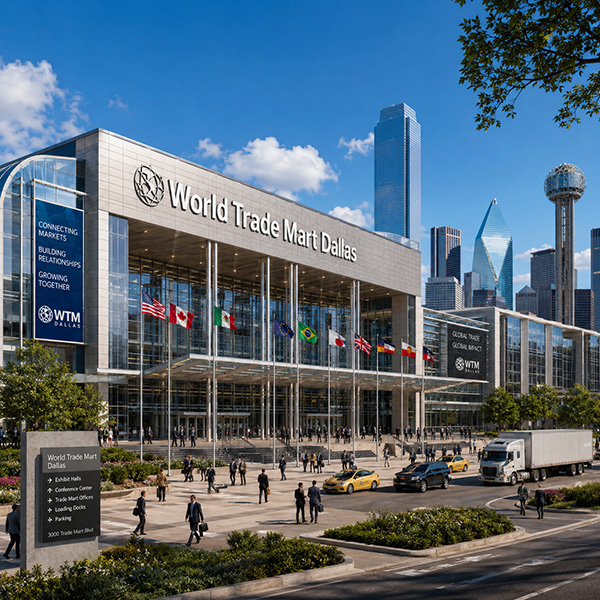
Invent City adapts proven commercial models for the future-of-cities market. Permanent marts, trade fairs, and showroom platforms work because they concentrate buyers, sellers, products, media, capital, and deal flow.
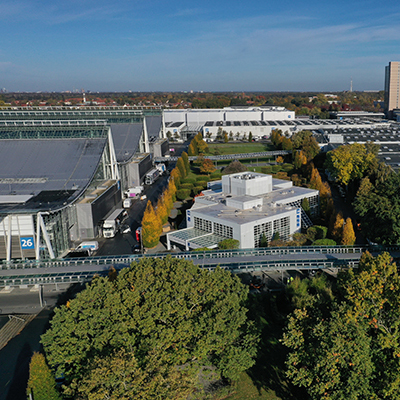
- Hannover Messe — Germany: global industrial platform for automation, energy, robotics, manufacturing, and industrial AI.
- transport logistic — Munich, Germany: international trade fair for logistics, mobility, IT, and supply chain management.
- SIAL Paris — France: major global marketplace for food, agriculture, retail, innovation, and supply chains.
- CEATEC — Japan: advanced technology platform focused on digital transformation, society, electronics, and implementation.
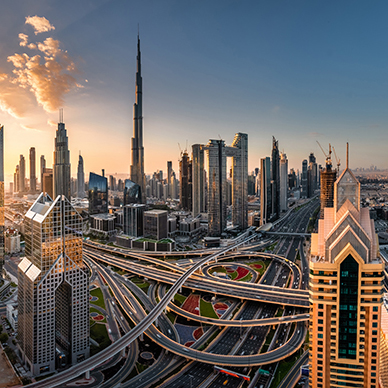
- Dubai World Trade Centre — UAE: major global venue connecting trade, technology, government, tourism, and international business.
- The MART — Chicago: permanent showroom marketplace model for design, interiors, products, buyers, and tenants.
The model is proven. Invent City changes the focus: urban systems, climate solutions, AI, robotics, infrastructure, and city operations.
Creating Value
The Trade Mart creates value by concentrating demand. For sellers, it puts customers, partners, investors, agencies, project teams, delegations, and media in one market.
- Demo better. Show complex systems in a real city context.
- Sell faster. Meet qualified buyers and project teams more efficiently.
- Build credibility. Use FiDi as proof, not just promotion.
- Scale relationships. Turn visits into pilots, financing, partnerships, and deployment.
Living Lab
FiDi makes the Trade Mart stronger than a conventional marketplace. Buyers can see how solutions perform in real urban conditions instead of relying only on pitches, brochures, or isolated demos.
- Find solutions. Discover vendors across multiple city systems.
- Compare options. Evaluate performance, cost, risk, fit, and ROI.
- Test before scaling. Use FiDi as a practical proving ground.
- Move to deployment. Connect solutions to financing, approvals, partners, and project teams.
Buyer–Seller Engine
The Trade Mart connects supply and demand. Sellers need qualified customers. Buyers need trusted solutions. Invent City puts both sides in a permanent marketplace built around urgent urban needs.
This is the commercial engine of the district.
Showrooms
Showrooms make urban solutions easier to buy. They turn complex products, systems, data, and services into experiences that customers can understand, compare, and trust.
- For companies: a permanent place to explain, demonstrate, and sell.
- For buyers: a faster way to compare options and reduce risk.
- For the district: recurring activity, visitors, events, tenants, and visibility.
Immersive Showrooms
Immersive showrooms turn sales pitches into proof. Buyers can experience future streets, buildings, parks, rooftops, waterfronts, mobility systems, and city operations before they invest.
- Make outcomes visible. Show savings, resilience, safety, comfort, and operating value.
- Use data and AI. Let buyers run simulations, scenarios, comparisons, and ROI models.
- Shorten decisions. Replace abstract claims with direct experience.
NYC
NYC gives Invent City instant credibility. It concentrates capital, media, talent, tourism, culture, real estate, agencies, universities, employers, and decision-makers.
What works in New York can travel. NYC turns Invent City into a global signal for companies, investors, buyers, and civic leaders.
FiDi
FiDi gives Invent City specific leverage. It has transit, Wall Street capital, global visibility, historic identity, waterfront risk, vacant space, and direct access to buyers, investors, agencies, founders, media, and civic leaders.
- It is visible. A global business district gives the platform credibility.
- It is connected. Transit, ferries, streets, and tourism bring people to the market.
- It is real. Buildings, streets, rooftops, waterfronts, and vacancies become test conditions.
IDCNY Comparison
IDCNY shows how showroom commerce can create a destination. Invent City applies that logic to the future of cities: showrooms, trade activity, events, design, technology, buyers, and market identity.
Use with the IDCNY comparison graphic.
Vacant Space
Vacant space is both a problem and an opportunity. FiDi’s empty offices, retail spaces, POPS, streets, parks, and public-realm assets give Invent City a faster, lower-cost launch path than new construction.
- For property owners: convert underused space into relevant tenancy, activity, NOI, and long-term value.
- For NYC: strengthen occupancy, street life, business activity, property values, and tax capacity.
- For companies: access lower-friction space in a global district with built-in visibility.
Urban Hubs
Urban hubs can put essential street services in one place. They can combine logistics, Blue Highway freight transfer, charging, battery exchange, micromobility, waste, storage, bathrooms, worker support, shade, water, wayfinding, and emergency response.
- Cleaner streets: fewer scattered services and less curb clutter.
- Better logistics: package transfer, micro-distribution, and freight staging.
- Human support: bathrooms, water, shade, seating, charging, and worker amenities.
- Deployable model: small nodes that can be tested, refined, and scaled.
Pedestrianization
Pedestrianization can turn streets into economic and civic assets. Invent City does not depend on it, but better public space can support visitors, events, retail, safety, mobility, cleaner streets, and a stronger district identity.
- Times Square — New York: pedestrian plazas helped turn a congested crossroads into a high-volume public space and global visitor destination.
- Oxford Street — London: proposed pedestrianization is framed as an economic-growth, jobs, retail, and public-realm strategy.
- Strøget — Copenhagen: an early pedestrian-street model that helped prove car-free central streets can support urban life and commerce.
- Fort Street — Auckland: a shared-street project associated with higher pedestrian volumes and increased consumer spending.
- Open Streets — New York: a broader public-space model that can support safety, local business, air quality, and neighborhood life.
AI
AI can become a major productivity layer for NYC. It can improve finance, real estate, healthcare, media, government, logistics, mobility, energy, buildings, and public services.
But AI also creates risk. It can automate bias, displace work, increase surveillance, hide accountability, and make critical systems harder to govern. Cities need places to test benefits and set standards before tools scale.
- Test performance. Does the tool actually save money, time, energy, or risk?
- Test governance. Who controls the data, decisions, security, and accountability?
- Test public value. Does it improve life for residents, workers, visitors, and operators?
Living Laboratory
FiDi can become a real-world place to test urban AI. Companies can prove what works, what saves money, what reduces risk, and what needs stronger oversight before cities scale it.
- Buildings: energy, maintenance, occupancy, safety, and retrofits.
- Streets: traffic, curb space, logistics, pedestrians, sensors, and safety.
- Waterfront: flooding, resilience, emergency response, and public-realm systems.
- Operations: service delivery, field work, inspections, routing, and reporting.
AI Showrooms
AI showrooms make the market easier to understand. Buyers, investors, agencies, operators, and delegations can compare tools, run simulations, review data, test ROI, and move faster.
- Show the system. Make invisible algorithms and data flows understandable.
- Compare alternatives. Evaluate tools side by side.
- Build confidence. Show performance, limits, risks, and governance before purchase.
24 / 7 Global Reach
Invent City should work beyond FiDi and beyond event dates. Digital channels, media, data, virtual showrooms, and AI tools can keep the platform active across time zones.
- Before a visit: help buyers discover companies, compare solutions, and plan meetings.
- During a visit: guide delegations through showrooms, demos, events, pilots, and data.
- After a visit: keep relationships moving toward pilots, procurement, financing, and deployment.